The Defensive Playbook: The Simplest Way to Stop Customer Churn (and Grow Your Business)
Here's the uncomfortable truth that most Microsoft 365 CSPs pretend does not exist:
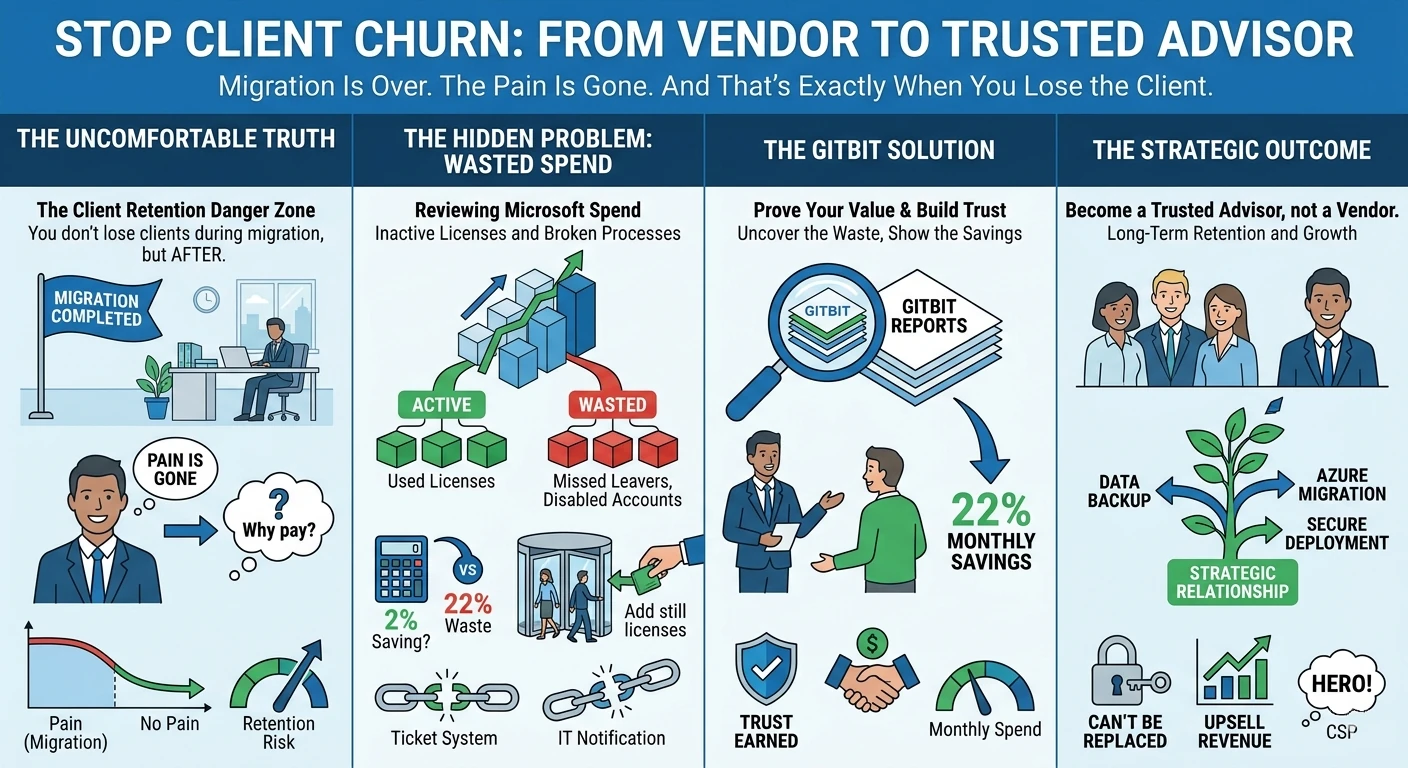
you don't lose clients during the migration. You lose them after.
After the mailboxes are moved, after Microsoft Teams is working. After all the pain of the migration slows down, the tickets start to trickle in. After all the fire drills and everyone finally gets to breathe again.
Once the pain is gone, clients look up and think, “Why am I still paying you?”
That's the danger zone. That's the time where you start to lose your clients. That time is upon us right now and it's only getting worse.
In my opinion, it's one of the most painful losses of a client. You didn't do anything wrong. There wasn't a problem you couldn't fix. Your customer support wasn't rude or slow to respond. The client simply said, “I don’t need you anymore.”
For Gitbit’s clients, the solution is easy.
The Problem: We’re Reviewing Our Microsoft Spend
If you've been in business for more than a year, I'm sure you've heard it. It's politely worded. Professional. And almost always says something like, “It’s not you. It’s me.”
They talk about how tough the economy is. They mentioned the margins of their own business that are no longer there. They explain that their leadership is coming down on them and they need to make cuts.
Honestly, it isn't actually about you. Your team didn't drop the ball, but your client is feeling the pressure and your two or three percent increase on Microsoft licensing no longer makes sense to them.
If they can cut their spend by two or three percent without losing services, why wouldn't they?
The Solution: Show Your Value Before They Look For The Door
We're not talking about spinning your value. We're not going to try and explain that Microsoft support is awful. You don’t need a fancy slide deck with pretty graphs.
You're going to prove your value by cutting their spending by 22% every single month.
You're not going to cut into your own margins. The client isn't going to receive less services. You're simply going to find the waste and show it to them.
By running a simple Gitbit report, you'll find the waste and prove your value.
"Right now, you're overspending by about 22%. Here's the breakdown. Here's exactly where it's happening. And here's precisely how we fix it."
Let that number land. You're saving them 22% every month. Not a one-time savings, not a rounding error. 22% of their recurring bill from Microsoft is going to be cut from their bill and they had no idea.
Because here's the thing: the cloud model was sold to the world as a pay-for-what-you-use model. It was supposed to save money by cutting expensive servers and cutting the IT workforce that had to manage it. But here's what they didn't tell you.
Every time a user leaves the organization and you don’t remove that license, you are paying for that license. Not for a couple of days, not for a month, but forever. Let's take an example.
Let's say your client has 100 employee turnover a month. Most of the time IT is notified. Most of the time IT simply disables the account and removes the license. But the world is messy.
Sometimes that happens, and then someone mentions they need an email or a file and it has to re-add that license. Or sometimes IT isn't notified. Or the ticket system breaks or the process breaks down. Here's the problem with the cloud.
If you have 100 employees replaced every month and just 5% are missed, 5% of those employees will still have a license and the customer will continue to be charged for those licenses. And the problem doesn't go away.
Five accounts turn into 10 accounts in a month. 10 accounts turn into 15 accounts a quarter. And all of a sudden, your client’s pretty little Microsoft 365 bill has an extra 15 users. Microsoft continues to bill but no one is using them.
When you find that waste and report it to your client, they'll know your value. Before renewal, you’ll want to run a Gitbit report for your current clients. Show them the money you are saving and something almost magical happens.
They no longer see you as a vendor. They no longer see you as an expense.
You’re the hero. You’re the advisor they not only want, you’re the friend they need.
You're the one they'll call when they're thinking of migrating to Azure. You are the one that will get the call when they are shopping around a new antivirus solution. You’re the one they will call when they need help desk or they need an expert that they don’t have in-house.
Gitbit Isn’t The Product. Your Trust Is.
Here's where most people miss the point.
Gitbit isn't the tool you use to save a client who's about to leave. It's not the tool you brag about to your clients and prospects.
The real value is what happens when you use Gitbit to build trust. When the audit isn't a rescue move but a regular touch point.
If you meet with your clients quarterly, share the report quarterly. If your clients have purchased Microsoft 365 licenses for an entire year, share the report with them two to three months before their licenses are renewed.
Don't wait for your clients to complain about their spending. Don't wait for your client to start shopping around. Don't wait for your client to realize they have 1,000 Microsoft 365 licenses and only 800 users.
If you wait, it's already too late.
If you bring them the report that shows how they can save money, you're the hero. That's not a support relationship. That's a strategic relationship. And strategic relationships don't get replaced by a cheaper partner who shows up with a lower price per seat. They're built on the kind of trust that's earned. And that's impossible to replace.
What client in their right mind would be mad at your 3 to 5% margin on their Microsoft 365 licenses when you just saved them 22% of their entire bill?
That client doesn't leave.
Now They Have The Budget To Address Their Next Pain
Once you understand the money, once you understand their budget, the upselling is easy. Let’s take a walk down a typical meeting with a Gitbit report in hand.
You show the client a report that says we can save you 22% on your Microsoft 365 bill. That’s a win for your trust. That’s a win for the client. But now there’s 22% of their budget that’s available. But you don’t just go into the next upsell.
Because here’s the thing: if you try to sell them the new hot piece of tech, it looks like you’re going after the money. Instead, meet their needs.
Have they mentioned they have concerns? Now’s the time to address them.
Have they had issues with attacks and hackers? Now they have the budget for your secure deployment.
Have they had concerns with data reliability? Now they have the budget for a backup solution.
Have their datacenter costs exploded? Now they have the budget to investigate moving some servers to Azure.
That’s how you grow your relationship. That’s how you help your clients with their issues. Not by a simple upsell, but through problem > pain > solution.
How The Story Ends
The client doesn’t leave.
They don’t go direct. They don’t chase a new partner offering a three-dollar-per-seat discount. They stay. Not because switching feels risky. Not because you’ve locked them in. But because they see your value.
They stay because every quarter, every license renewal, you show up. You make their business a little more efficient. You cut the fat and make their life a little easier.
You’re not the migration vendor anymore. You’re not the help desk they tolerate because you’re the cheapest. You’re the trusted advisor that’s saving them money. Next time they’re called in front of their board, they’re giving you the praise.
That’s retention. That’s how you stop customer turnover. Not with hidden cancellation fees. Not with a subscription trap or holding their data hostage, but becoming the trusted advisor that can’t be replaced.
Now that you know how to stop customer churn, jump over to the Offensive Playbook and learn how to grow your Microsoft 365 client list.
Ready to buy today or curious about price? Hop over to our pricing page to learn more.
More Guides
- The Offensive Playbook
- Gitbit's Super Simple Pricing Model
- How To Purchase Gitbit Licenses
- How To Cancel Gitbit Licenses
- Convincing Prospects To Let You Run A Report
- How To Log In To Gitbit
- How To Run A Gitbit Audit Report
- How To Gain Insights Using The Gitbit Audit Report
- How To Handle Objections
- Managing Your Team In Gitbit
- How To Contact Gitbit Support