Artificial Intelligence (AI) for Executives and Top-Level Managers: Understand Artificial Intelligence

Artificial Intelligence is an extremely powerful exponential technology which is used in applications ranging from Maximizing Advertising ROI and Chatbots to Self-Driving Cars and Automatic Crop Harvesting.
In this short, Executive Briefing course, you will get a bird’s eye view of the field of Artificial Intelligence, understand how it works and why it’s one of the most disruptive technologies which has potential to add massive value to your business.
What is unstructured data?
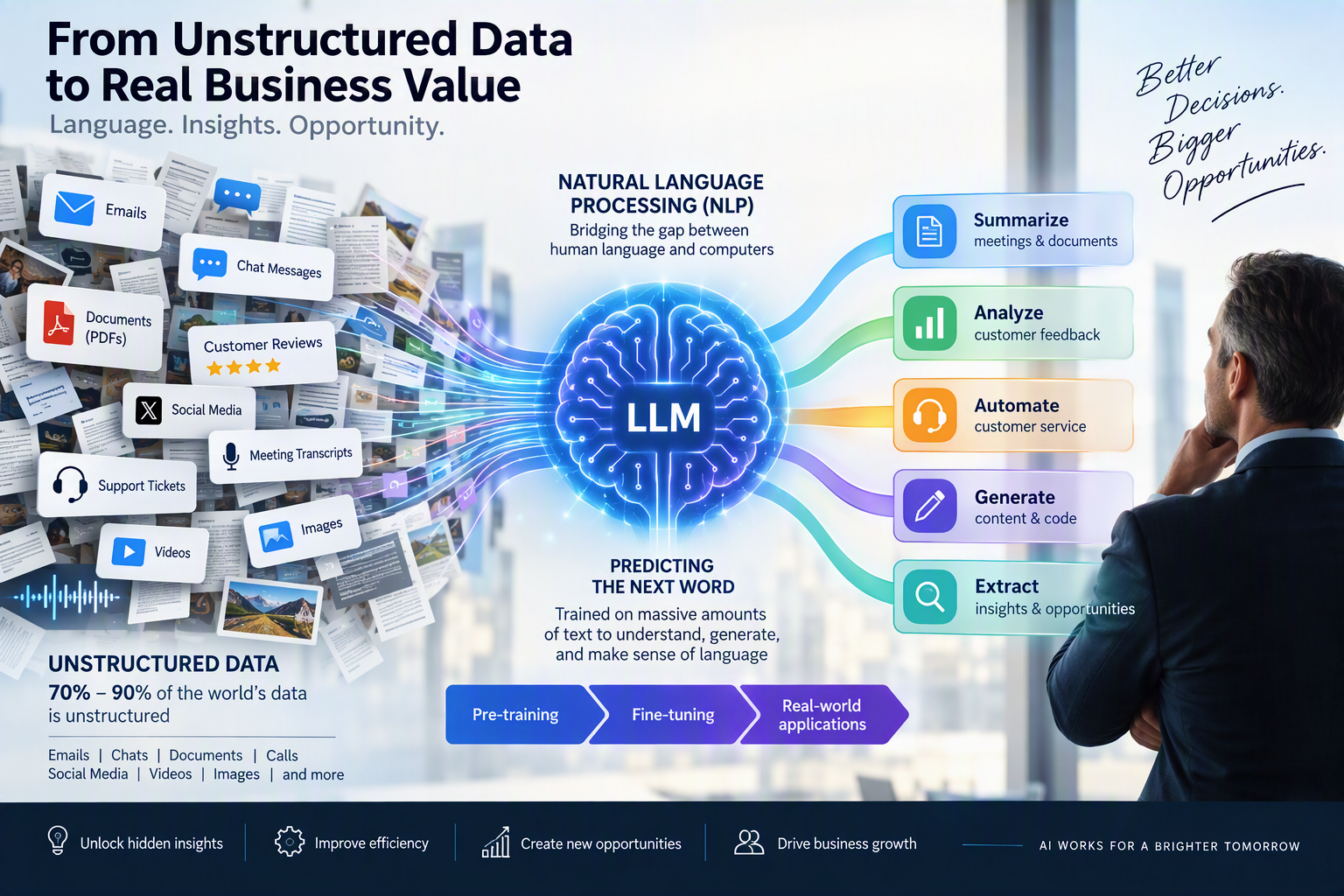
70% to 90% of the world's data is hiding in plain sight. The weird part? Most businesses can't actually understand it.
Natural Language Processing, or NLP, sounds like one of those buzzwords that gets tossed around in AI presentations right before someone shows a complicated diagram nobody remembers.
But the core idea is surprisingly simple.
Humans talk. Computers don't.
At least, they don't naturally.
NLP is the branch of artificial intelligence that tries to bridge that gap. It's the technology behind systems that can read emails, summarize meetings, analyze customer reviews, transcribe phone calls, answer questions, and make sense of the endless stream of language we produce every day.
And we produce a lot of it.
Before NLP makes sense, though, there's a distinction worth understanding.
There are really two kinds of data in the business world.
The first is structured data.
Structured data lives in neat rows and columns. Think spreadsheets, databases, CRM records, inventory systems. It has rules. Every field has a place. A computer loves this stuff because it already knows where to look.
If you've ever filtered an Excel sheet or run a report from a database, you've worked with structured data.
Then there's unstructured data.
This is where things get messy.
Emails. Chat messages. Support tickets. Contracts. Meeting transcripts. Blog posts. PDFs. Audio recordings. Videos. Images.
All of it contains information, but none of it arrives in a tidy format.
Humans don't communicate in database tables. We communicate through stories, opinions, questions, complaints, jokes, and half-finished thoughts typed on a phone while standing in line for coffee.
That's unstructured data.
And here's the part that surprised me when I first learned it: depending on the source, somewhere between 70% and 90% of the world's data is unstructured.
That's not a rounding error.
It means most of the information organizations collect is locked inside formats that traditional systems struggle to understand.
Imagine a company with ten years of customer emails.
Buried in those messages are patterns about product issues, feature requests, customer frustrations, buying signals, competitor mentions, and opportunities for improvement.
The information is there.
The problem is that nobody has time to read millions of emails.
The same thing happens with support chats, sales calls, survey responses, meeting recordings, and internal knowledge bases. Valuable insights exist. They're just trapped inside language.
This is where NLP becomes interesting.
Not because it's flashy.
Because it finally gives businesses a way to work with the kind of information humans create most naturally.
A customer writes a review? NLP can identify the sentiment.
A sales team records hundreds of calls? NLP can surface common objections.
Employees ask the same question repeatedly in chat? NLP can detect the pattern and help automate responses.
Suddenly, data that was previously ignored becomes searchable, measurable, and actionable.
That's why NLP has exploded over the last few years.
Organizations aren't adopting it just because AI is trendy. They're adopting it because they've realized they already possess enormous amounts of valuable information. The challenge is extracting meaning from it at scale.
In a way, every company is sitting on a library filled with answers. Customer needs. Operational bottlenecks. Emerging risks. Hidden opportunities.
The books are already on the shelves.
NLP is simply the tool that finally lets you read them.
What are Large-Language-Models (LLM)?
The Engine Behind Generative AI Isn't Magic. It's Language. A surprisingly simple idea is reshaping how businesses work, create, and communicate.
Large Language Models (LLMs) are the technology powering most generative AI tools today. They learn patterns from massive amounts of text, allowing them to understand, generate, and interact with human language.
From summarizing articles and drafting emails to analyzing documents and generating code, LLMs are transforming both everyday experiences and business operations. Companies use them to automate tasks, unlock insights from data, improve customer service, and create content faster.
As LLMs continue to evolve, they're becoming a foundational technology that is redefining how people and organizations work.
How does GenAI Work?
The Surprising Truth About AI: It’s Not Thinking, It’s Predicting
What looks like intelligence is really a breathtakingly fast game of “what comes next?”
Most people imagine a large language model, or LLM, as something that reasons its way through a question like a human would. That's the wrong mental model.
At its core, an LLM does one thing: it predicts the next word.
Seriously. That's the whole game.
When you type a prompt into an AI system, the model looks at your words and calculates which word is most likely to come next. Once it picks one, that new word becomes part of the input. Then it predicts the next word after that. And the next. And the next. Repeat this process thousands of times in a matter of seconds, and you get paragraphs that feel surprisingly human.
The impressive part isn't the task. It's the scale.
Before an LLM can generate useful responses, it goes through a massive training process. The first stage is called pre-training. During this phase, the model consumes enormous amounts of text from books, websites, articles, forums, encyclopedias, and other public sources. We're talking about billions of pages of content.
As it works through that data, the model constantly practices predicting missing words, identifying patterns, and understanding how sentences relate to one another. Over time, it develops a statistical map of language. Not knowledge in the human sense. Not understanding. Just an extraordinarily sophisticated ability to recognize patterns in text.
Then comes fine-tuning, where things get interesting for businesses.
A pre-trained model is powerful, but still general-purpose. Fine-tuning adapts that foundation to specific tasks using smaller, focused datasets. One organization might train a model to assist customer service teams. Another might use it to analyze legal contracts, summarize technical documents, or support internal knowledge management.
This is where generative AI becomes more than a technology demo. It becomes a business tool.
The real magic isn't that AI can perform one specialized function. It's that the same underlying model can be adapted to solve a wide range of challenges. From broad conversational assistants to highly specialized industry applications, organizations can tailor the technology to improve efficiency, accelerate decision-making, and unlock new ways of working.
And it all starts with a surprisingly simple objective: predicting the next word.
What Makes GenAI So Special?
The Real Secret Behind LLMs Isn’t Intelligence. It’s Context.
Everyone says AI can think. The truth is a lot stranger.
Contrary to popular belief, large language models (LLMs) do not think or reason the way humans do. At their core, they perform a surprisingly simple task: predicting the next word in a sequence, over and over again. One word. Then the next. Then the next.
So if that's all they're doing, why do they seem so intelligent?
The answer lies in the architecture that powers them: the transformer.
Developed by researchers at Google, the transformer solved one of the biggest limitations of earlier machine learning models. It gave AI the ability to understand context across long stretches of text rather than treating language as a series of disconnected words.
A simple example shows why this matters.
Consider the sentence: "The dog didn't cross the street because it was too tired." Most people instantly understand that "it" refers to the dog.
Now change a single word: "The dog didn't cross the street because it was too wide." Suddenly, "it" refers to the street, not the dog.
Nothing changed except one word, yet the meaning shifted completely.
Older AI systems struggled with this kind of relationship. They could recognize individual words, but they often failed to understand how those words interacted within a broader context. The transformer changed that. By analyzing connections between words throughout a sentence, paragraph, or even an entire document, it can determine meaning based on context, not just definitions.
And that's the real breakthrough. LLMs don't understand language like humans do, but they are remarkably good at tracking context. That ability is what makes conversations feel natural, text generation feel human, and AI useful across everything from customer service to business innovation.
Applications of GenAI
The Companies Winning With AI Aren’t Using It the Way You Think
Eight practical applications already reshaping how businesses work, communicate, and grow.
If you're still thinking of generative AI as a chatbot that answers questions, you're missing the bigger picture. The real story is how quietly it's becoming part of everyday business operations.
Customer service is one of the most obvious examples. AI-powered chatbots and virtual assistants can handle common questions around the clock, giving customers immediate support while freeing employees to tackle more complex issues. Nobody enjoys waiting on hold, and businesses are finally finding a way around it.
Content creation is another area moving fast. Marketing teams are using AI to draft campaigns, write emails, summarize reports, and personalize communications at a scale that would have been difficult just a few years ago. The goal isn't replacing humans. It's removing the blank page.
Then there's language. Generative AI can translate content in real time, helping organizations communicate across countries and cultures without the usual delays and costs. A conversation that once required multiple specialists can now happen almost instantly.
Software development may be where the productivity gains are most visible. AI coding assistants help developers generate code, troubleshoot problems, and explore solutions faster. Research from GitHub found that developers using Copilot completed tasks significantly faster, highlighting how AI can act as a collaborative partner rather than just another tool.
Behind the scenes, AI is also transforming legal and compliance work. Contracts, policies, and regulatory documents can be reviewed and analyzed more efficiently, reducing manual effort while improving consistency.
Companies are also turning to AI for sentiment analysis and market research. By examining customer feedback, social media discussions, and market trends, organizations can spot changing preferences before competitors do.
Human resources is another natural fit. From screening resumes to supporting onboarding and answering employee questions, AI can streamline repetitive processes and improve the employee experience.
My favorite application might be knowledge retrieval. Every company has valuable information buried in documents, emails, and databases. Generative AI helps employees find what they need quickly, reducing wasted time and improving decisions.
These are just eight examples, but they point to a larger trend. The businesses seeing the biggest gains aren't treating AI as a novelty. They're embedding it into the work that happens every single day.
10 Case Studies
Forget the hype cycle for a minute. These ten case studies show what happens when AI moves from slide decks to daily operations, and the results are a lot more tangible than most people realize.
AI conversations often drift into the future. What might happen. What could change. The more interesting story is what's happening right now. Across finance, healthcare, retail, automotive, legal services, and software development, companies are already using AI to save time, reduce costs, improve customer experiences, and unlock entirely new ways of working.
Goldman Sachs: Turning Knowledge Work Into a Competitive Advantage
Few industries face as much pressure to balance productivity, compliance, and accuracy as investment banking. Goldman Sachs has responded by rolling out its in-house AI assistant, a generative AI chatbot designed specifically for bankers, traders, and employees across the organization.
The assistant helps with tasks that consume an enormous amount of time: summarizing lengthy documents, drafting emails, preparing briefing notes, and creating speech content. These are jobs that are repetitive but still critical. By reducing the manual effort involved, employees can spend more time focused on decision-making and client work.
More than 10,000 employees now use the system, with early results showing meaningful productivity gains across the business.
Cera: Preventing Health Crises Before They Happen
One of the most compelling AI use cases is happening in healthcare. UK-based home care provider Cera uses predictive AI to improve outcomes for elderly and vulnerable patients.
Its fall-prevention system can predict up to 83% of falls before they occur, while its hospitalization prediction platform flags over 80% of health risks in advance. That changes the equation entirely. Instead of reacting after a crisis happens, caregivers can intervene earlier.
The impact is substantial. Hospitalizations have been reduced by as much as 70% among patients using the service, generating estimated savings of £1 million per day for the NHS. On top of that, AI scheduling tools slash administrative work and reduce travel time, giving carers more time to focus on actual patient care.
HACEB: Giving Field Technicians Instant Expertise
Appliance servicing sounds straightforward until you realize that technicians often work across thousands of product variations, each with multiple potential failure modes.
Colombian manufacturer Haceb tackled this challenge with Wilson, an AI-powered assistant designed to support its network of 245 technicians. During more than 1,000 service visits per day, technicians can instantly access service manuals, repair histories, wiring diagrams, and troubleshooting guidance.
The assistant covers more than 1,200 appliance models, helping workers solve problems faster and with greater confidence. The result is an 8% to 10% reduction in service time per visit, which adds up to roughly 83 hours saved every day across the organization.
Adobe: Accelerating Creativity Instead of Replacing It
The debate around AI and creative work often misses an important point. Most professionals don't want creativity automated. They want the repetitive parts removed.
That's exactly where Adobe has focused its efforts. By embedding generative AI features across products like Photoshop, Illustrator, and other tools in its ecosystem, the company helps designers move faster without sacrificing quality.
Hundreds of AI-driven capabilities now assist with image editing, design generation, content creation, and collaboration. The practical benefit is shorter production cycles and less time spent on tedious tasks. Adobe's continued annual revenue growth of more than 10% suggests customers see real value in that strategy.
Yum! Brands: Reinventing the Fast-Food Drive-Thru
Fast food is fundamentally an operations business. Small improvements, repeated millions of times, can create enormous value.
Yum! Brands, the parent company of Taco Bell, Pizza Hut, and KFC, is partnering with Nvidia to deploy AI-powered voice ordering systems across hundreds of restaurant locations. The company's long-term goal is ambitious: push all orders through digital channels.
AI ordering systems can improve consistency, reduce wait times, capture data more effectively, and create a smoother customer experience. Investors clearly liked the vision. Around the time the Nvidia partnership was announced, Yum! Brands' stock climbed by roughly 30%, reflecting confidence in its digital-first strategy.
Walmart: Making Retail More Personal
Walmart's AI strategy isn't focused on one feature. It's an ecosystem approach that touches nearly every stage of the customer journey.
The retail giant uses AI, generative AI, and augmented reality to personalize shopping experiences, streamline customer support, simplify returns, and improve product discovery. One standout example is Retina, Walmart's augmented reality platform, which generates tens of thousands of 3D product assets.
Those assets help customers visualize products more effectively before purchasing. That's not just a better shopping experience. It also reduces returns, which is one of the biggest hidden costs in retail. As adoption of AR features has grown dramatically, investors have rewarded Walmart's technology investments with strong market performance.
BMW: Managing Hundreds of Millions of Customer Interactions
BMW's mobile app has evolved far beyond being a digital key. Today, it acts as a real-time connection between drivers and their vehicles.
The My BMW app serves roughly 13 million active users and processes an astonishing 450 million requests every day. It handles vehicle data, status updates, maintenance notifications, and personalized recommendations based on driving habits.
Generative AI helps make those interactions faster, smarter, and more relevant. Rather than forcing drivers to navigate complex menus, the system increasingly anticipates needs and simplifies communication. It's a strong example of AI quietly enhancing customer experience at massive scale.
LexisNexis: Amplifying Legal Expertise
Legal professionals spend countless hours researching cases, drafting documents, and reviewing information. LexisNexis believes AI can dramatically reduce those burdens.
Its legal assistant, Protégé, combines proprietary models with technologies from providers such as OpenAI and Anthropic. The platform supports conversational legal research, drafting assistance, document analysis, and case summarization.
The key idea is not replacing lawyers. It's making their expertise more valuable. By reducing the time required to understand a topic or prepare a document, attorneys can focus on strategy, judgment, and client relationships. That's why some industry leaders believe top legal professionals could command even higher billing rates in an AI-enabled future.
InspectionXpert One: Improving Quality Control in Manufacturing
Manufacturers lose enormous amounts of money to defects, recalls, and quality issues. InspectionXpert One addresses that problem through a combination of computer vision and generative AI.
The platform automates inspections across mobile devices, production lines, and standalone inspection stations. After more than 40 million completed inspections, the company reports impressive results: 85% defect detection accuracy, a 45% reduction in costs, and a 60% increase in output.
The most impressive statistic may be the speed of return on investment. Many customers are reportedly achieving ROI within three months, which is rare for large-scale technology initiatives.
BrowserStack: Building Better Software Faster
Testing has always been one of the biggest bottlenecks in software development. BrowserStack is using AI to change that.
Its AI-enhanced testing platform functions almost like an additional team member, automatically generating tests, adapting to interface changes, and identifying issues before they become major problems. By combining Azure OpenAI capabilities with deep platform integration, the system helps development teams maintain high testing accuracy while reducing manual work.
The gains are significant: reduced QA cycles, lower maintenance requirements, stronger test coverage, and faster software releases. In an industry where speed often determines success, those improvements can create a meaningful competitive advantage.
The common thread running through all ten examples is surprisingly simple. The biggest AI wins aren't coming from futuristic robots or fully autonomous businesses. They're coming from targeted applications that remove friction, improve decision-making, and help people focus on higher-value work. That's where the real value is being created today, and it's likely where the next wave of transformation will happen as well.
Computer Vision
Most people use computer vision every day without realizing it. The real surprise is how much work it’s already doing behind the scenes.
Computer vision is a branch of artificial intelligence that enables computers to interpret and understand images and video. While the concept dates back to the 1950s, it remained relatively limited for decades. A familiar early example is the barcode scanner, which uses visual data to identify products. Useful, but narrow in scope.
What changed? Computing power, data availability, and advances in AI. Over the last decade, computer vision has gone from a niche technology to something woven into everyday life. When your smartphone camera recognizes a face and automatically focuses on it, that’s computer vision. When social media platforms suggest people to tag in a photo, the same technology is at work. Even self-driving vehicles rely heavily on computer vision to understand their surroundings and make decisions.
The business potential is even more exciting. Humans process most information visually, which means countless jobs and workflows have traditionally depended on human observation. Think about traffic monitoring, medical image analysis, sports officiating, retail checkouts, equipment inspections, and transportation operations. These tasks require people to constantly watch, identify, and evaluate visual information.
Computer vision allows many of these activities to be automated. In many cases, computers can analyze visual data faster, more consistently, and with fewer errors than humans. The result is improved efficiency, reduced operational costs, and the ability for employees to focus on work that requires creativity, judgment, and problem-solving.
That’s why computer vision is often considered one of the most accessible and impactful AI technologies for organizations. It builds on something businesses already have: visual information. As the technology continues to improve, companies across industries are discovering new ways to use computer vision to streamline operations, create better customer experiences, and unlock opportunities that were previously impossible.
How Does Computer Vision Work?
Computer Vision Is Not Just Neural Networks. That Myth Is Costing People Better AI Decisions
Most conversations about computer vision start halfway through the story. Here's the missing half that changes how you think about AI.
Ask someone how computer vision works and there's a good chance they'll jump straight to neural networks. Deep learning has become so dominant that many people assume it's the only way computers can understand images. It isn't.
That's the first thing worth clearing up.
Computer vision actually has two major branches: classical computer vision and deep learning. They solve similar problems, but they go about it in very different ways.
Classical computer vision is the older approach. Instead of learning everything from scratch, it relies on pre-built libraries of features. Think of it as giving a computer a toolkit filled with patterns it already knows how to recognize.
Imagine you're building a system that detects faces. A classical computer vision algorithm doesn't need to discover what eyes, noses, and mouths look like on its own. It can use predefined features that help it locate those elements quickly and efficiently. The same idea applies to many everyday objects. Cars, utensils, signs, and countless other common items already have established feature libraries available.
The biggest advantage? Speed.
Classical methods are often remarkably fast and surprisingly accurate when the problem is well understood. They don't require massive datasets, expensive training processes, or huge amounts of computing power. Sometimes the simplest solution really is the best solution.
Then there's deep learning.
This is the branch that gets most of the attention today, largely because of its impressive results across a wide range of visual tasks. The technology behind it is commonly based on convolutional neural networks, or CNNs.
A useful way to think about a CNN is as a black box with an enormous capacity to learn from experience. Unlike classical computer vision, nobody manually programs the features the model should look for. Instead, the model discovers them on its own.
Suppose you show the network tens of thousands of labeled images of dogs and cats. At first, the images are just collections of pixels. But over time, the network begins identifying patterns that help separate one animal from the other.
Maybe it notices pointy ears, whiskers, or the shape of a face. Maybe it learns that certain textures, proportions, or visual cues appear more frequently in one category than the other. The exact internal process is difficult to interpret, which is why people often describe these systems as black boxes.
Eventually, the network builds its own collection of learned features. When it encounters an image it has never seen before, it applies those learned patterns to make a prediction.
This same process can be extended far beyond cats and dogs. A neural network can learn to distinguish recyclable plastic bottles from general waste, identify manufacturing defects, detect medical abnormalities, or classify thousands of other visual categories. The catch is that it usually needs a large amount of labeled data to do so effectively.
The takeaway is simple. Computer vision is not a one-tool discipline. Classical methods remain extremely valuable for many common detection tasks, especially when speed and efficiency matter. Deep learning shines when problems become more complex, specialized, or difficult to solve with predefined features.
The smartest AI teams don't treat these approaches as competitors. They treat them as tools and choose the right one for the job.
Tomato Sorting Example
The Tomato Test: A Boring Conveyor Belt Hides One of AI’s Biggest Opportunities
Most people hear “computer vision” and think self-driving cars. The smarter lesson might be sitting in a crate of tomatoes.
Before diving into all the flashy applications of computer vision, it helps to start with something almost ridiculously ordinary: sorting tomatoes.
Imagine you run a wholesale produce company. Every day, thousands of tomatoes roll down a conveyor belt on their way to grocery stores. Quality matters. A few rotten or unripe tomatoes slipping through can damage customer trust, create waste, and cost real money.
So you hire people to watch the belt and remove the bad ones.
It's a simple process. It also comes with some obvious problems.
First, labor costs add up. If you need multiple workers performing the same repetitive task all day, every day, that's a significant operational expense.
Second, people make mistakes. Even highly attentive workers miss things occasionally. After staring at tomatoes for hours, concentration naturally drops.
Third, humans simply aren't as fast as machines. There is a limit to how quickly someone can inspect products moving along a belt.
Then there are the practical realities of running a business. Employees get sick. They take vacations. They have unexpected emergencies. None of that is a problem. It's just life. But it does create points of failure in a process that needs to run consistently.
And honestly, there's another issue that often gets overlooked.
Very few people dream of spending their careers identifying bad tomatoes on a conveyor belt. Human talent is usually better spent on work that requires creativity, judgment, communication, or problem-solving.
This is where computer vision becomes interesting.
Instead of relying entirely on manual inspection, you could place a camera above the conveyor belt and begin collecting images. The system would observe which tomatoes workers allow to continue and which ones they remove.
Without changing the process, you'd already be building a valuable dataset.
The tomatoes that stay on the belt become examples of acceptable products. The ones removed become examples of unripe or rotten products. In other words, your existing operation is creating training data for you.
After gathering enough examples, a deep learning model can begin recognizing the same patterns that workers use when making decisions.
The goal isn't magic. The goal is replication.
You're teaching a machine to perform a narrow task extremely well.
Once the model reaches a reliable level of accuracy, you can connect it to a simple mechanical system that automatically removes defective tomatoes from the line.
Suddenly the economics of the operation change.
Costs decrease because fewer people are needed for repetitive inspection work. Accuracy improves because the model applies the same standards consistently. Processing speed increases because software can evaluate images in fractions of a second. Operational interruptions become less common because the system doesn't call in sick or need a day off.
Most importantly, people can be reassigned to higher-value work.
That's the real lesson hidden inside the tomato example.
Computer vision isn't just about futuristic technology. It's about finding repetitive visual decisions that humans already make and teaching machines to handle them at scale.
Once you start seeing that pattern, opportunities appear everywhere. In manufacturing, logistics, healthcare, agriculture, retail, and dozens of other industries.
The tomatoes are just the beginning. The idea is much bigger than the produce aisle.
Applications of Computer Vision
Most people think computer vision is just facial recognition. That’s like saying the internet is just email.
Computer vision has become one of those technologies that hides in plain sight. You interact with it every day, often without realizing it. Open your phone, join a video call, drive a newer car, scan a receipt, browse a map. Chances are computer vision is doing something useful behind the scenes.
At its core, computer vision is the ability for computers to interpret and understand visual information. And because video is really just a rapid sequence of images, most computer vision techniques work on both images and videos.
The most familiar application is image classification. This is the technology that answers simple but valuable questions: Is this a dog or a cat? Is this product defective or functioning correctly? It takes an image and assigns it to a category. Straightforward, but incredibly powerful when applied across millions of images.
Then there’s image segmentation, which goes a step further. Instead of labeling an entire image, it separates the image into distinct regions. A good example is the background blur feature in video conferencing apps. The software identifies where you end and the background begins, then treats those regions differently.
Object detection adds another layer of intelligence. It not only identifies whether an object exists but also pinpoints where it is. A system can detect pedestrians, vehicles, products on a shelf, or safety hazards on a factory floor. Modern systems can recognize multiple objects at once and draw boxes around each of them. In some highly specialized tasks, computers now outperform humans. For instance, certain image recognition systems can identify dog breeds with accuracy levels that exceed typical human performance.
Object tracking takes detection and adds movement over time. It's not enough to know that a pedestrian exists. The system wants to know where that pedestrian is going. This capability plays a major role in autonomous driving and advanced safety systems. One well-known example involved a vehicle applying its brakes moments before a collision became visible to the driver, demonstrating how tracking can help prevent accidents.
Not every application is about recognition. Image generation focuses on creating or transforming visual content. It can transfer styles between images, reconstruct scenes from photographs, or help generate three-dimensional representations from two-dimensional inputs. Mapping platforms use related techniques to build immersive 3D views of cities and landmarks.
Edge detection may sound technical, but it solves a simple problem. It identifies the boundaries of objects. By finding where shapes begin and end, computers gain a much clearer understanding of what they're looking at.
Face detection and facial recognition are often confused. Face detection simply finds faces in an image. Facial recognition attempts to determine whose face it is. One identifies a presence; the other identifies an individual.
Optical Character Recognition, better known as OCR, allows computers to read text from images, scanned documents, and even handwriting. It's one of the most mature computer vision technologies and often achieves remarkably high levels of accuracy.
Finally, pattern detection and feature matching help computers recognize similarities across images. These techniques power everything from product searches to image organization systems.
The fascinating thing about computer vision isn't any single application. It's how many industries can benefit from it. Once you start looking for these eleven capabilities, you realize they're already everywhere. And chances are, there's a place for them in your business too.
Case Studies of Computer Vision
Most people think AI is still in the experimentation phase. Meanwhile, a construction worker just got an extra hour back in their day, a truck cut fuel consumption by double digits, and a factory avoided a costly shutdown because a camera noticed something a human never would.
For years, computer vision felt like one of those technologies that was always just around the corner. You'd see impressive demos. Self-driving car prototypes. Research papers. A robot identifying cats in blurry images. Interesting, sure. But a little distant.
That's no longer the case.
Computer vision has quietly crossed an important threshold. It isn't just a futuristic capability anymore. It's solving real business problems right now, often in industries that don't get much attention from the tech world. Construction sites. Waste facilities. Manufacturing plants. Mining operations. Places where productivity gains aren't measured in clicks, but in hours, accidents avoided, fuel saved, or millions of dollars recovered.
What's fascinating is that many of these applications aren't replacing workers. They're helping people spend less time on repetitive, inefficient, or error-prone tasks and more time on work that actually matters.
Let's look at ten examples that show just how practical computer vision has become.
Construction Workers Were Walking Six Miles a Day
One of the most striking examples comes from Skanska, one of the world's largest construction companies.
Construction sites are incredibly complex environments. Materials move constantly. Equipment gets relocated. Teams spread out across massive areas. Everyone assumes a certain amount of walking is simply part of the job.
Then Skanska measured it.
The company discovered that workers were walking roughly six miles every day just trying to access tools, materials, and equipment.
That's a remarkable amount of time spent not actually building anything.
Using computer vision systems combined with activity data, Skanska analyzed how workers moved throughout construction sites. Instead of relying on assumptions or supervisor observations, they could see precisely where inefficiencies existed.
The result was surprisingly simple. Put resources where workers actually need them.
That optimization reduced daily walking by about two miles per worker. More importantly, it gave back approximately one hour of productive time per employee each day.
A one-hour gain may not sound dramatic until you multiply it across hundreds or thousands of workers. Suddenly you're looking at productivity improvements approaching 12%.
Not bad for something that started with cameras watching people walk.
The Truck That Thinks Ahead
Fuel is the largest operating expense for many logistics companies. Margins are already thin, and every wasted gallon matters.
The tricky part is that driving behavior has an enormous impact on consumption. Aggressive acceleration, unnecessary braking, and poor speed management can dramatically increase fuel usage.
The startup Hypermile tackled this problem from an interesting angle.
Rather than building new vehicles, they created an AI-powered cruise control system called Hypermile Copilot that can be retrofitted into existing commercial trucks.
Using computer vision and machine learning, the system continuously analyzes road conditions and traffic flow. It anticipates gradients, adjusts speed intelligently, and maximizes opportunities for coasting.
The idea sounds almost mundane until you look at the results.
Diesel consumption dropped by around 11%.
Electric truck range increased by roughly 15%.
In an industry under mounting pressure to reduce emissions while maintaining profitability, those numbers are significant. What's particularly clever is that the system isn't demanding new infrastructure or a new fleet. It's making existing vehicles smarter.
Sometimes innovation isn't about replacement. It's about optimization.
A Factory That Never Stops Watching
Manufacturing has a hidden problem that rarely gets discussed.
Small issues become expensive issues.
A minor deviation on a production line might look harmless at first. An unusual movement. A slight delay. A process operating just a little differently than normal.
Humans often miss these signals.
The Swiss startup Syrian approached the problem by turning ordinary CCTV cameras into intelligent observers.
Their AI platform learns what normal production behavior looks like. Once it understands the baseline, it begins monitoring for anomalies automatically.
No supervisor needs to constantly stare at screens.
No worker must manually note every irregularity.
The system identifies deviations as they occur and flags them before they evolve into major failures.
What makes this valuable isn't just automation. It's consistency.
Humans get tired. They get distracted. They overlook details after watching the same process for hours.
A computer vision system does not.
Manufacturers using the technology have reported production loss reductions exceeding 30%, a figure that can translate into substantial savings for large operations.
The Death of the Checkout Line
Nobody enjoys standing in line.
Retailers don't love it either.
Long checkout times create friction, discourage purchases, and reduce customer satisfaction. Labor shortages have only made the challenge worse.
Meshgin's solution feels almost like magic when you first hear it.
Their self-checkout kiosks use computer vision to identify multiple products simultaneously without requiring traditional barcode scanning.
Customers place items down.
The cameras identify them.
Done.
Packaged goods, fresh foods, and multiple products at once can all be recognized through image analysis.
The company reports checkout time reductions approaching 90%.
In high-volume environments such as airports, stadiums, and convenience stores, that's a major improvement.
Even more interesting are reports of significant revenue increases after deployment. Faster checkout means less abandonment, quicker service, and more transactions completed during peak demand periods.
We've all experienced the frustration of waiting longer to pay for something than it took to choose it.
Computer vision is quietly eliminating that problem.
The Camera That Helps Patients Take Their Medicine
Healthcare has a surprisingly simple challenge with enormous consequences.
Many patients don't take medication as prescribed.
Estimates suggest adherence rates hover around 50%, meaning millions of people miss doses, take incorrect amounts, or stop treatment altogether.
The problem isn't always intentional.
Life is messy.
People forget.
They get distracted.
They become confused about instructions.
AiCure developed smartphone software that uses computer vision to verify medication adherence.
The system can determine whether patients are taking the right medication, at the right time, and in the correct quantity.
This creates objective monitoring without requiring constant supervision from healthcare professionals.
Early results showed adherence rates reaching approximately 95%.
That's a dramatic improvement, particularly for populations that may struggle with treatment consistency, including individuals facing substance abuse challenges or certain mental health conditions.
Sometimes a camera can help in ways that feel surprisingly human.
Monitoring Oil Wells From Miles Away
Oil and gas operations often involve remote facilities scattered across vast geographic regions.
Checking equipment traditionally requires physical visits, even when nothing is wrong.
That's expensive.
It's also inefficient.
Osprey Informatics applied computer vision to continuous monitoring of remote oil wells.
Instead of relying solely on scheduled inspections, their systems analyze video feeds and identify operational issues automatically.
Functioning sites can be left alone.
Problems receive immediate attention.
The benefits aren't complicated.
Fewer unnecessary trips.
Faster detection.
Lower monitoring costs.
In fact, monitoring expenses reportedly fell by roughly 50%.
When a technology cuts costs while simultaneously increasing responsiveness, industries tend to pay attention quickly.
Which is exactly what happened.
Teaching Machines to Recycle Better Than Humans
Humanity generates more than two billion tons of waste annually.
What's frustrating is how much of it could be recycled.
A huge percentage of recyclable material still ends up discarded simply because sorting remains difficult and expensive.
The Norwegian facility known as ROAF took a bold approach.
Instead of relying primarily on people sorting waste by hand, they created a largely automated system powered by computer vision.
Cameras identify materials moving through processing lines.
AI determines what is recyclable.
Machines sort accordingly.
The facility processes roughly 40 tons of waste per hour while achieving accuracy levels as high as 97%.
For perspective, it serves approximately 190,000 residents.
This isn't just an environmental success story.
It's an economic one.
Billions of dollars worth of recyclable material are discarded each year. Improving sorting accuracy means recovering value that would otherwise be lost.
Waste, after all, is often just misplaced resources.
Helping Stroke Patients Recover
Some applications of computer vision have little to do with business metrics and everything to do with human lives.
Stroke affects millions of people globally every year.
Many survivors face long rehabilitation journeys involving the recovery of coordination, dexterity, and motor function.
Traditionally, measuring progress requires trained specialists.
That can be expensive and difficult to scale.
Researchers at the Swiss Federal Institute of Technology developed a computer vision system capable of evaluating recovery progress automatically.
The software monitors movement patterns and measures rehabilitation outcomes that professionals previously assessed manually.
The technology remains relatively early in development, but the potential is enormous.
More accessible monitoring.
Lower rehabilitation costs.
Broader access to recovery tools.
Sometimes the most exciting application of technology isn't efficiency. It's giving people a better chance to get their lives back.
Making Workplaces Safer
Industrial workplaces are inherently risky environments.
Construction sites and manufacturing facilities contain heavy machinery, dangerous materials, and countless opportunities for mistakes.
Many injuries occur because workers aren't wearing required protective equipment.
Not because they don't care.
Because people sometimes forget.
Cortex addressed this challenge with continuous computer vision monitoring.
Their software identifies whether workers are wearing appropriate safety gear and immediately alerts organizations when compliance issues arise.
Think of it as a safety manager who never blinks.
The potential impact is substantial. Widespread implementation could prevent thousands of workplace accidents annually while reducing enormous costs associated with injuries and downtime.
It's easy to focus on productivity gains when discussing AI.
Safety gains may be even more important.
Sorting Rocks, Saving Energy
Mining rarely makes headlines in discussions about artificial intelligence.
Yet it's one of the most resource-intensive industries in the world.
Separating valuable minerals from waste consumes enormous amounts of energy and water because target materials often exist in very small concentrations.
Tomra's solution uses computer vision to identify higher-value ore before additional processing occurs.
When valuable particles are detected, short bursts of air separate them from less promising material.
That means less material moves through energy-intensive downstream processes.
The company reports energy savings approaching 15%, along with significant reductions in water usage.
For an industry responsible for approximately 3% of global energy consumption, those improvements matter.
A lot.
The Bigger Story
Looking across all ten examples, a pattern emerges.
Computer vision isn't succeeding because cameras suddenly became better. Cameras have been around for decades.
What's changed is the software's ability to understand what it's seeing.
A worker walking too far.
A truck approaching a hill.
A product on a checkout counter.
A missing hard hat.
A recyclable bottle.
To humans, these observations feel obvious.
To machines, they used to be nearly impossible.
Now they're routine.
And that's why computer vision may end up being one of the most economically significant forms of artificial intelligence. It operates in the physical world, where inefficiencies are expensive and outcomes are measurable.
There is no hype hidden inside an extra hour of productivity. No buzzword buried in lower fuel consumption. No marketing spin behind fewer accidents or improved medical adherence.
Those are tangible outcomes.
They're happening today.
And if there's a lesson buried inside these stories, it's this: the future of AI probably won't arrive as one dramatic breakthrough. It will arrive as thousands of small improvements, scattered across factories, hospitals, construction sites, trucks, recycling centers, and mines.
Most people won't notice.
Until they realize the entire system around them suddenly works better than it used to.
Deep Learning
The technology behind self-driving cars and cancer detection has been around for decades. So why did it suddenly change everything?
Most people hear the phrase “deep learning” and imagine something futuristic. Giant data centers. Robots making decisions. Machines quietly plotting to replace human work. The reality is less dramatic, but honestly, far more interesting.
Deep learning is a branch of machine learning, which itself sits inside the broader field of artificial intelligence. Think of it like a set of nested boxes. Artificial intelligence is the biggest box. Machine learning is one box inside it. Deep learning is another box tucked inside machine learning.
That hierarchy matters because it explains what deep learning is actually trying to accomplish.
Artificial intelligence is the broad goal of creating systems that can perform tasks we normally associate with human intelligence. Machine learning narrows that goal down. Instead of programming every rule by hand, we give computers data and let them learn patterns. Deep learning takes that idea one step further by using structures called artificial neural networks.
The phrase sounds intimidating, but the core idea is surprisingly simple.
Humans have never discovered a more powerful data-processing system than the brain. It can recognize faces instantly, understand language, detect patterns, and learn from experience. Naturally, computer scientists wondered whether some of those ideas could be borrowed.
Artificial neural networks are the result.
They are not miniature brains. Not even close. Comparing a neural network to the human brain is a little like comparing a paper airplane to a fighter jet. They share a few concepts, but one is vastly more sophisticated than the other. Still, neural networks borrow a basic principle: learning through exposure and experience rather than through an exhaustive list of predefined rules.
That distinction is what makes deep learning so different from many traditional approaches.
Imagine you're trying to build a program that tells the difference between cats and dogs.
With older methods, engineers might create a long list of features. Does the animal have pointy ears? What is the average size? How long is the snout? How much fur is visible? The computer would then use those human-defined rules to make a decision.
Deep learning flips the process around.
Instead of telling the computer what features matter, you simply show it thousands, or even millions, of labeled examples. Here is a cat. Here is another cat. Here is a dog. Here are ten thousand more dogs.
At first, the neural network is terrible at the task. Its guesses are basically random. But over time, it starts finding patterns hidden in the data. It discovers that certain shapes, textures, proportions, and visual relationships tend to correspond with cats while others tend to correspond with dogs.
Nobody explicitly tells it that pointy ears might matter. Nobody programs a "cat detector" by hand. The network learns those features on its own.
That's the beauty of deep learning and also the reason it became such a big deal.
For decades, data scientists spent enormous amounts of time designing features manually. Deep learning automated much of that work. Instead of engineers telling the system what is important, the system learns what is important directly from the data.
Of course, there is a catch.
Actually, there are several.
The biggest limitation is data. Deep learning is hungry. Incredibly hungry.
A human child can see a few examples of an object and recognize it later. Neural networks are nowhere near that efficient. They often require thousands, tens of thousands, or even millions of examples before they become truly competent.
Training these systems also requires substantial computing power. Large neural networks perform millions or billions of calculations during training. That wasn't practical for most organizations during the 1980s and 1990s.
Which brings us to one of the most misunderstood facts about deep learning.
It isn't new.
The fundamental ideas behind neural networks have existed for decades. Researchers developed many of the underlying concepts long before today's AI boom. The problem wasn't theory. The problem was hardware.
Back then, computers simply weren't powerful enough.
Imagine inventing a race car engine before roads existed. The idea might be brilliant, but the surrounding technology can't support it. That is more or less what happened with deep learning. Researchers understood the potential, but the available computing resources made large-scale neural networks impractical.
Then everything changed.
Processing power became dramatically cheaper. Graphics processing units, often called GPUs, made it possible to perform huge numbers of calculations simultaneously. Storage became affordable. Massive datasets became available through the internet and digital systems.
Suddenly, neural networks had everything they needed.
The results were remarkable.
In areas like image recognition, speech recognition, language translation, and handwriting analysis, deep learning systems began outperforming many traditional machine learning techniques. Tasks that once seemed stubbornly difficult became surprisingly manageable.
Handwritten text recognition is a great example. Traditional methods often struggled to move much beyond respectable accuracy levels. Deep learning models, given enough data and computing power, pushed performance dramatically higher. The difference wasn't always a few percentage points. Sometimes it was transformative.
That's why deep learning receives so much attention today.
Not because it's magical. Not because it resembles science fiction. And certainly not because it suddenly appeared out of nowhere.
The excitement comes from something more practical. Deep learning demonstrated that machines could learn complex patterns directly from data at a scale that previous approaches struggled to achieve.
In many ways, deep learning is a lesson in patience. The idea arrived decades before the world was ready for it. The theory waited. Computing power caught up. Data became abundant. And suddenly an old concept looked revolutionary.
That's usually how real breakthroughs happen. They aren't always new. Sometimes they're just waiting for the rest of technology to catch up.
Building Neural Networks
If neural networks can teach themselves, why are machine learning experts among the most sought-after people in tech?
One of the biggest misconceptions about artificial intelligence is the idea that it simply appears, starts learning, and magically figures everything out on its own. I get why people think that. We keep hearing phrases like “self-learning algorithms” and “autonomous AI,” which make it sound as if humans are barely involved.
The reality is a lot more interesting.
At the heart of deep learning sits something called a neural network. In its simplest form, a neural network takes information in through an input layer and produces an answer through an output layer. Think of it as a system of connected digital neurons working together to recognize patterns.
Here's where things start to get complicated.
Engineers can place one or more hidden layers between the input and output. These hidden layers allow the network to process information in increasingly sophisticated ways. Add a few hidden layers, and you have what is known as a deep neural network. Add more, and the network becomes capable of tackling much harder problems.
But there isn't just one way to build a neural network.
One model might have six neurons in a hidden layer. Another could have eight neurons, then two, then six again, creating a bottleneck shape. Some networks are wide. Others are deep. Some are optimized for images, while others are better suited for language, forecasting, or recommendation systems.
These design choices are known as the network's architecture.
And that's exactly why machine learning engineers and data scientists remain so valuable.
The algorithm may learn from data once it's running, but someone has to decide how the learning system is structured in the first place. Choosing the right architecture is not a mechanical task. It's part science, part engineering, and part creative problem-solving. Two experts can look at the same challenge and design completely different solutions.
That's what companies are paying for.
The hard part isn't teaching a neural network to learn. The hard part is building a neural network that can learn the right thing efficiently, accurately, and reliably. A poor architecture can waste enormous amounts of time, data, and computing power. A great architecture can unlock performance that seemed impossible.
So yes, deep learning systems can teach themselves. But only after skilled humans create the environment where that learning can happen. The AI gets much of the attention, yet behind every successful deep learning model is a person who figured out how to build the right brain for the job.
How Neural Networks Learn
Everyone talks about AI like it's magic. Under the hood, though, it's mostly a giant machine that keeps adjusting numbers until it gets less wrong.
Neural networks have a reputation for being intimidating. People hear terms like backpropagation, hidden layers, activation functions, and deep learning, then quietly decide this must be something only researchers can understand.
Honestly, I think that's backwards.
The technical details get complicated fast, but the core idea is surprisingly simple. In fact, if you understand one concept, you understand the heart of modern AI: neural networks learn by adjusting weights.
That's it. That's the engine.
Imagine a tiny neural network. It has four neurons in an input layer, five neurons in a hidden layer, and one neuron in an output layer. Real-world models are dramatically larger, but the principle remains the same.
Every connection between neurons has a weight attached to it. Think of each weight as a dial. Some dials amplify information. Others weaken it. The entire learning process is really just the network figuring out where those dials should be set.
When people say a neural network is being "trained," they're not teaching it facts in the way you might teach a person. They're adjusting thousands, millions, or even billions of these weights until the network starts making useful predictions.
Here's how information flows through the system.
The input layer receives data. Each neuron in the hidden layer takes those inputs, multiplies them by their corresponding weights, combines the results, and produces a new value. Then the output layer does something similar with the values coming from the hidden layer.
The network starts with random weights. That's important. At the beginning, it knows absolutely nothing. Its predictions are basically guesses.
Now let's use the classic example: distinguishing dogs from cats.
Suppose you have a huge collection of labeled images. Each image already has the correct answer attached. This one is a dog. That one is a cat.
Before the network sees the image, the image must be converted into numbers. Computers don't understand fur, tails, or floppy ears. They understand numerical values.
Each pixel becomes data. Those values are organized into a vector and fed into the input layer. In a toy example, there might be only four inputs. In reality, there could be tens of thousands or hundreds of thousands.
The image enters the network.
Calculations happen.
An answer comes out.
Maybe the network predicts "dog."
Then something interesting happens.
Because we already know the correct label, we can compare the prediction against reality. If the image truly contains a dog, the network did well. If the image is actually a cat, the network made a mistake.
That mistake becomes valuable feedback.
The network essentially asks itself, "How wrong was I?"
The answer is translated into a numerical error value. Then a process called backpropagation pushes that error backward through the network. Connections that contributed to the wrong prediction have their weights adjusted.
Not dramatically. Just a little.
That's the part many people underestimate.
Learning doesn't happen in one giant leap. It happens through countless tiny corrections.
Wrong.
Adjust.
Try again.
Wrong again.
Adjust again.
Repeat.
Thousands of times. Millions of times.
Over time, the weights slowly move toward values that produce better results.
Eventually, patterns begin to emerge inside the network. No one explicitly programs rules like "dogs often have this shape" or "cats tend to have these facial features." The network discovers useful patterns on its own because the adjusted weights start responding to recurring characteristics in the training data.
This is also why deep learning is so hungry for data.
A handful of examples usually isn't enough. The network needs to see enormous numbers of cases before the underlying patterns become clear. The more varied and representative the training data, the better chance it has of learning something useful rather than memorizing examples.
What's fascinating is that the dog-versus-cat problem isn't fundamentally different from many business problems.
Take customer churn.
Instead of image pixels, the inputs might be customer demographics, location, purchase history, product usage, support interactions, and spending habits.
Each customer becomes a collection of numbers.
The output isn't "dog" or "cat." Instead, it might be a probability that the customer leaves within the next six months.
Historical customer data becomes the training set. Customers who stayed and customers who left provide the answers the system needs to learn from.
The same learning cycle happens.
Prediction.
Comparison.
Error calculation.
Weight adjustment.
Repeat.
After enough iterations, the network becomes surprisingly effective at recognizing warning signs that humans might overlook.
The exact same logic can be applied to real estate valuation. Inputs could include square footage, location, age of the property, number of bedrooms, school district quality, and available parking.
Feed in historical sales data, adjust the weights repeatedly, and eventually the network learns patterns associated with market value.
This is why neural networks have become such a powerful tool across industries. Healthcare, finance, retail, logistics, manufacturing, and marketing all share one thing in common: inputs that can be measured and outcomes that can be predicted.
Strip away the buzzwords, and the story gets simpler.
A neural network starts ignorant.
It sees examples.
It makes mistakes.
It adjusts a massive set of weights.
Then it makes slightly fewer mistakes.
The cycle continues until the network becomes useful.
That's the real secret. Not magic. Not consciousness. Not some mysterious digital brain.
Just an enormous collection of adjustable numbers, gradually learning from experience, one tiny correction at a time.
Deep Learning And Other Areas of AI
Deep learning supercharges other AI fields, but the real story is why it works and where it doesn’t.
Artificial intelligence is often talked about as if it were a single technology. It isn’t. Think of it more like a big umbrella. Under that umbrella sits machine learning. And within machine learning live several powerful disciplines, including reinforcement learning, natural language processing (NLP), and computer vision.
Here’s where things get interesting.
A lot of people assume deep learning contains all of these fields. It doesn’t. Reinforcement learning can work without deep neural networks. NLP existed long before modern deep learning models. Computer vision solved plenty of useful problems before anyone started stacking dozens of neural network layers together.
Deep learning is less of a replacement and more of an upgrade.
When you combine deep learning with one of these technologies, you add the pattern-recognition power of deep neural networks. Reinforcement learning becomes deep reinforcement learning. Computer vision becomes deep computer vision. NLP becomes deep NLP. The core problem remains the same, but the tool solving it becomes far more capable.
Why does that matter?
Because deep neural networks can uncover relationships in data that traditional approaches often miss. Given enough data and computing power, they can test countless pathways, refine their understanding, and improve performance in ways that were once impractical. That extra flexibility is often why deep learning systems achieve higher accuracy.
Of course, there’s a catch. Nothing comes free.
Deep learning typically demands significantly more computational resources, larger datasets, and longer training times. If the infrastructure isn’t available, the added complexity may not be worth it. Sometimes a simpler model gets the job done just fine.
Still, in many real-world applications, adding deep learning produces meaningful gains. It’s not a miracle cure, and it won’t solve every problem. But when used thoughtfully, it can amplify the capabilities of reinforcement learning, NLP, and computer vision, turning already powerful technologies into something considerably more effective.
10 Case Studies of Deep Learning
1. Google AI & Cancer Detection
Cancer remains the world’s second deadliest disease, claiming nearly 10 million lives annually and causing more than $1 trillion in economic losses. The challenge is not just treatment. It is diagnosis. Even highly trained pathologists disagree on breast and prostate cancer cases more than half the time. That gap is where Google AI steps in. By training deep learning models on massive datasets, researchers built a system that detects metastasis with 89% accuracy, compared with 73% for pathologists, even when given unlimited time. The technology is not replacing experts, but helping them make faster, more reliable decisions for patients everywhere.
2. Co-counsel
Legal professionals can spend more than 60% of their working hours reviewing documents, analyzing contracts, and conducting research. These tasks are essential, but they are also repetitive and time-intensive. As legal matters become more complex and workloads continue to grow, firms and in-house departments need smarter ways to maintain accuracy without adding overhead.
That’s where CoCounsel comes in. Trained on more than 150 years of authoritative legal content, CoCounsel acts as an AI-powered legal assistant that helps professionals review, summarize, draft, and research faster than ever before. Rather than switching between multiple platforms, lawyers can ask questions directly within CoCounsel and receive clear, reliable answers backed by trusted legal sources.
The results are hard to ignore. More than 12,000 law firms and nearly 5,000 legal departments use CoCounsel, reporting significant time savings, higher-quality work product, and reduced research burdens.
3. Goldspot Discoveries And How They Use Deep Learning In Mineral Exploration
Finding gold is getting harder. The easy discoveries are largely gone, and the world's non-renenewable resources are becoming more expensive to locate and extract. Mining companies now have to search deeper underground and across larger areas, driving up both costs and timelines.
The numbers tell the story. In the 1990s, major gold discoveries averaged around 15 per year. Today, that figure has fallen to just one or two annually. What's surprising is that exploration budgets have doubled, and in some cases tripled, over the same period.
That's where Goldspot Discoveries took a different approach. Instead of collecting more data, they used deep learning to extract better insights from existing geological information. The result was a predictive model capable of identifying hidden gold deposits with remarkable accuracy.
In Quebec, the system correctly identified 86% of known gold deposits while analyzing data from only 4% of the province's total surface area. That's not just efficiency. That's a completely different way to explore.
4. Digital Domain & Visual Effects
Visual effects are now woven into almost everything we watch, from Super Bowl commercials to the biggest films on the planet. In blockbuster productions, VFX can consume 20% to 50% of the total budget, sometimes climbing past $100 million. That's a staggering amount of money spent on something audiences aren't supposed to notice.
A great example is Thanos in Avengers: Endgame. The team at Digital Domain used deep learning technology trained on high-resolution scans of actor Josh Brolin's face, allowing the character to be rendered in near real time. That changed the filmmaking process. Instead of waiting days or weeks to review finished effects shots, directors could see a much closer version of the final scene while filming.
I think that's the real breakthrough. Better feedback leads to better creative decisions. The result was visual effects that felt natural, helping Endgame earn critical praise and nearly $3 billion worldwide.
5. Ayasdi & Anti-Money Laundering
Money laundering quietly moves between one and two trillion dollars each year, representing roughly two to five percent of global GDP. Stopping it does more than protect banks. It also disrupts terrorism financing, human trafficking networks, and narcotics distribution. One of the world’s largest financial institutions partnered with Ayasdi to deploy a deep learning solution aimed at strengthening anti money laundering efforts. The target seemed modest: improve operational efficiency by three percent. The outcome was far bigger. Investigative volume dropped by more than twenty percent, and the bank uncovered a previously unseen risk segment, reducing regulatory exposure alongside meaningful insights.
6. Cybersecurity
Cybercrime drains roughly $600 billion from the global economy each year, and the problem is accelerating. Autonomous AI-driven attack tools can now probe systems in minutes, shrinking the time organizations have to respond. One Fortune 500 company discovered just how exposed it was after deploying Deep Instinct’s deep learning security platform. Within the first week, the system identified 12 infected endpoints. Continued monitoring revealed that nearly 10% of devices were compromised despite existing traditional protections. Remarkably, the platform used less than 1% CPU while achieving a 99% success rate in blocking malware, including 140 ransomware threats.
7. Doxil for Productivity Tracking
Construction has a visibility problem. Roughly 80% of projects run over budget, and the average schedule slips by nearly 20 months. One reason is surprisingly simple: progress tracking often relies on site walks, manual measurements, visual inspections, and clipboards. In an industry building some of the world’s most complex assets, that approach feels stuck in another era.
The consequences are hard to ignore. While manufacturing has dramatically improved productivity over the past two decades, construction efficiency has barely moved, growing by only about 1%.
That’s where Doxel comes in. Using deep learning, the company analyzes data gathered by robots and drones moving through construction sites. The system compares real-world progress against project plans, spotting delays, deviations, and risks before they become expensive problems.
The impact can be dramatic. On one project, labor productivity increased by 38%, and the final delivery came in 11% under budget. Sometimes, seeing clearly changes everything.
8. Photo Room
Most photo editing tools promise speed. PhotoRoom actually scaled it. Founded in France, the company built an AI powered platform that helps users remove backgrounds, create realistic scenes, and transform product photography almost instantly. The numbers are hard to ignore: more than 150 million downloads and roughly 5 billion images processed each year. Its proprietary image generation architecture runs up to 40% faster than many competing solutions, giving sellers an edge when time matters. Features such as Instant Diffusion make it easier to produce consistent, on brand product photos and scale visual content across marketplaces with remarkable speed and reliability.
9. Zestimate & Real Estate Prices
Real estate isn't just a big industry. It's the largest sector of the U.S. economy, accounting for more than 30% of GDP. That scale creates enormous opportunity, but it also brings intense competition. To keep up, many real estate firms are leaning on artificial intelligence to solve problems that have long slowed the industry down.
One of the biggest challenges is property valuation. A nationwide shortage of appraisers has made accurate pricing more expensive and time-consuming, creating delays for buyers, sellers, and agents alike.
That's where Zillow's Zestimate comes in. Using deep learning, the system analyzes home characteristics, unique property features, and both on-market and off-market data to estimate the value of nearly 100 million homes across the United States.
The results are impressive. For listed properties, Zestimate reports a median error rate of just 1.9%. That level of accuracy allows agencies to spend less time on appraisals and more time building relationships, attracting clients, and closing deals.
10. Zest Finance & Loan Approval
Roughly seven million people in the United States are currently at least three months behind on their car payments, a sign that financial strain is colliding with aggressive lending practices. The problem cuts both ways. Some borrowers take on obligations that exceed their means, while some lenders accept greater risk in pursuit of growth and revenue.
That tension creates a costly challenge: identifying who is likely to repay a loan and who may eventually default. This is where deep learning has started to make a real difference.
One example is Zest Finance, which developed a deep learning system designed to evaluate creditworthiness and predict lending risk more accurately than traditional methods. By uncovering patterns that older models often miss, the technology helped a leading U.S. auto lender reduce annual losses by 23%.
It is a practical reminder that deep learning is already delivering measurable business results, not someday, but today.
What is Reinforcement Learning (RL)?
Most people think AI is taught. The surprising part? Some of the most powerful systems learn by stumbling around and getting things wrong.
When people first hear about artificial intelligence, they often imagine a machine absorbing knowledge the way students absorb information from a textbook. In reality, machine learning comes in a few very different flavors, and understanding those differences makes reinforcement learning much easier to appreciate.
Let's start with unsupervised learning. This is the explorer of the machine learning world. Instead of being told what to look for, the algorithm searches for patterns on its own. Imagine giving it a database of customer information and asking it to find meaningful groups. It might discover clusters of customers who behave similarly, spend similar amounts, or share certain preferences. Nobody hands the machine those categories in advance. It creates them based on the data it sees.
Supervised learning works differently. Here, the machine is more like an apprentice learning from examples. Suppose you want a system that can tell the difference between dogs and cats. You first provide thousands of images that are already labeled. Some are marked "dog," others "cat." The algorithm studies these examples and gradually learns which features tend to belong to each category. After enough training, it can look at a brand-new image and make an educated guess about whether it's seeing a dog or a cat.
That brings us to reinforcement learning, which feels like a completely different game.
Instead of learning from labeled examples, an artificial agent learns through experience. It exists within an environment and interacts with it by taking actions. After each action, it receives feedback. Good outcomes earn rewards. Bad outcomes trigger penalties. The objective is simple: maximize rewards over time.
What makes this fascinating is that the agent is not given detailed instructions. Nobody provides a step-by-step guide explaining how to solve the problem. The system begins with very little knowledge and learns through trial and error.
Think about a robot trying to walk for the first time. If you've ever watched a toddler learn to walk, you already understand the basic idea. The robot attempts a movement. Sometimes it falls. Sometimes it manages to stay upright. When it successfully moves forward while maintaining balance, it receives a positive reward. When it crashes to the floor, it receives a negative one.
At first, its behavior may look random or even ridiculous. But over thousands or millions of attempts, patterns emerge. Actions that consistently lead to rewards become more common. Actions that lead to failure gradually disappear. Eventually, the robot discovers a walking strategy on its own.
This same principle can be applied to much more than walking. Reinforcement learning has been used to train systems to navigate complex environments, master challenging games, and even coordinate teams of robots in activities that resemble soccer. The remarkable part is that these abilities often emerge from a simple reward structure rather than an explicit set of rules.
That is the essence of reinforcement learning: learning not by being told what to do, but by discovering what works. And in many ways, that's what makes it one of the most exciting frontiers in machine learning today.
Reinforcement Learning in Humans
The same invisible force that teaches a child to take its first steps is powering some of the most exciting breakthroughs in AI. Once you see the connection, reinforcement learning feels a lot less like computer science and a lot more like life.
Reinforcement learning is one of those ideas that sounds highly technical until you realize you've been watching it happen since the day you were born.
In fact, humans use reinforcement learning constantly. One of the best examples is a baby learning to walk.
Think about what happens when a baby first starts standing up. It doesn't receive a manual. Nobody uploads a walking algorithm into its brain. Instead, it experiments. It tries something, observes the outcome, and gradually figures out what works and what doesn't.
Sometimes those experiments go badly.
A baby may shift its weight awkwardly, lose balance, and fall. The fall creates pain, and the nervous system sends signals to the brain. Pain isn't something that exists out in the world waiting to be discovered. It's an internal signal, generated by the body and interpreted by the mind. To the brain, that signal acts as negative feedback.
Without consciously analyzing the event, the baby's brain begins associating certain movements with undesirable outcomes. Actions that lead to pain become less likely to be repeated. In reinforcement learning terminology, the baby has received a negative reward.
Now consider the opposite scenario.
The baby manages to take a few wobbly steps forward and reaches a shiny toy across the room. Maybe it hears applause from its parents. Maybe it experiences excitement, curiosity, or joy. These positive feelings become rewards. The brain strengthens the connection between the actions that produced those rewards and the successful outcome.
As this cycle repeats thousands of times, the baby gradually improves. Not because it was explicitly taught every movement, but because it learned through trial and error. It explored, received feedback, and adapted.
That is the core idea behind reinforcement learning.
An AI agent interacts with an environment much like the baby interacts with the world. It takes actions, receives rewards or penalties, and adjusts its behavior to maximize positive outcomes over time. Success is reinforced. Failure is discouraged.
What makes reinforcement learning so fascinating is how closely it mirrors natural learning. While no AI system today truly thinks the way humans do, reinforcement learning captures a fundamental principle of intelligence: learning from experience.
That's why many researchers consider it one of the most promising paths toward more capable artificial intelligence. At its heart, reinforcement learning isn't just about machines getting smarter. It's about understanding a process that humans have been using all along, often without even realizing it.
Advantages of Reinforcement Learning
Recently, I interviewed Jon Langford, who works at Microsoft Research and with over 50 published research
papers, is recognized as one of the world's leading researchers in the space of reinforcement learning.
You can find this interview in episode number 275 of the Super Data Science Podcast.
If you'd like to learn more.
One of my most exciting takeaways from this conversation with Jon is that reinforcement learning is
the future of machine learning.
Why?
Here's a quote from Jon.
There are many situations where you just can't label data effectively.
You have to learn from rewards.
And since supervised learning relies on large labeled datasets, reinforcement learning has a much higher
scope of application than any form of supervised learning.
That was advantage number one that reinforcement learning doesn't require large labeled data sets.
It's a massive advantage because as the amount of data in the world grows, it becomes more and more
costly to label it for all required applications.
Here are some other advantages of reinforcement learning.
Advantage number two is that it's innovative, unlike reinforcement learning.
Supervised learning is actually imitating whoever provided the data for that algorithm.
The algorithm can learn to do the task as well or better than the teacher, but can never learn a completely
new approach to solving the problem.
On the other hand, reinforcement learning algorithms can come up with entirely new solutions that were
never even considered by humans.
Advantage number three is bias resistance.
If there's bias in the way the data is labeled, then a supervised learning algorithm will pick up that
bias and learn inherit that bias.
In this sense, reinforcement learning algorithms are better tools to find solutions free from bias
or discrimination.
Advantage number four is online learning.
Reinforcement learning runs in real time.
Reinforcement learning combines exploration when the machine tests new approaches on on the fly to find
better solutions, and exploitation when the machine exploits the best solutions which it has found
thus far.
This means that it can bring results while improving at the same time.
Other algorithms would actually require retraining and redeployment in order to accomplish that.
Reinforcement learning just keeps going.
Advantage number five is that it's goal oriented.
Reinforcement learning can be used for sequences of actions.
While supervised learning is mostly used in an input output manner.
Reinforcement learning can be used for tasks with objectives such as robots playing soccer or self-driving
cars getting to their destinations, or an algorithm maximizing return on investment on ad spend and
advantage.
Number six is that reinforcement learning is adaptable.
Unlike supervised learning algorithms, reinforcement learning doesn't require retraining because it
adapts to new environments automatically on the fly.
So there we go.
Those were six advantages of reinforcement learning.
Knowing these advantages can help you decide if reinforcement learning is the right tool for the artificial
intelligence applications that you have in mind for your organization, in your industry.
The Self-Driving Vacuum That Trained Itself to Clean Your House
It keeps smashing into walls, getting stuck under chairs, and making terrible decisions. Then something strange happens: it gets smart.
One of my favorite examples of reinforcement learning isn't a robot beating a world champion at chess or an AI dominating a video game. It's a robot vacuum trying not to embarrass itself.
Imagine you've built a brand-new robotic vacuum. You place it in a messy living room and give it one simple goal:
Clean as much floor as possible.
That's it.
You don't tell it where the couch is. You don't explain how to navigate around furniture. You don't provide a map. You just give it a set of possible actions:
Move forward
Turn left
Turn right
Stop
At first, the vacuum is basically a clueless toddler.
It drives straight into walls.
It wedges itself under a coffee table.
It spins in circles for no apparent reason.
If this were a human employee, you'd probably fire it by lunchtime.
But here's where reinforcement learning gets interesting.
Every time the vacuum cleans a new patch of floor, it earns a small positive reward.
+1 reward.
Every time it bumps into a wall, it receives a negative reward.
-5 reward.
Every time it gets stuck somewhere and can't move, the penalty is even larger.
-20 reward.
The vacuum's objective is simple: maximize total rewards.
So it begins experimenting.
Once upon a time, it drove forward near a wall and crashed.
Negative reward.
Next time it's in a similar situation, it becomes slightly less likely to repeat that action.
Later, it approaches the same wall and turns right instead.
No crash.
Small reward.
That behavior becomes a little more attractive.
The process repeats thousands, sometimes millions, of times.
Crash. Learn.
Succeed. Learn.
Get stuck. Learn.
Escape. Learn.
What's fascinating is that nobody explicitly teaches the robot strategies like, "Stay six inches from walls" or "Avoid table legs at a forty-five-degree angle." Those behaviors emerge naturally because they produce higher rewards.
Over time, the vacuum starts looking intelligent.
Not because it understands houses.
Not because it understands furniture.
Not because it understands cleaning.
It simply learned which actions tend to produce better outcomes.
That's reinforcement learning in a nutshell.
The same idea powers some of the most impressive AI systems ever created.
When DeepMind's AlphaGo defeated world champion Lee Sedol in 2016, it wasn't because engineers programmed every possible Go strategy by hand. The system played millions of games against itself, receiving rewards for winning and penalties for losing. Gradually, it discovered strategies that no human had ever considered.
The crazy part is that the underlying principle isn't all that different from a baby learning to walk.
The baby takes an action.
The world responds.
The brain receives feedback.
The action is either reinforced or discouraged.
A robot vacuum does the same thing.
So does an AI mastering a game.
So do you.
Every skill you've ever learned, from riding a bike to giving presentations to parallel parking a car, followed the same pattern: act, receive feedback, adjust, repeat.
That's why reinforcement learning feels so powerful. It doesn't just resemble intelligence. It resembles learning itself.
And learning, more than raw knowledge, is what intelligence has always been about.
The AI That Learned to Beat the World’s Best Go Player
A machine taught itself in 40 days what took humanity 2,500 years to discover.
For years, people believed the ancient board game Go would be one of the last strongholds of human intelligence. Chess had fallen. Checkers had fallen. But Go felt different.
The game is deceptively simple. Two players place black and white stones on a 19×19 board, trying to control territory. The rules can be learned in minutes.
Mastering it is another story.
There are more possible Go positions than atoms in the observable universe. That's not a typo. The number is so absurdly large that brute-force calculation is practically useless. Unlike chess, where computers could evaluate many moves ahead, Go requires intuition, pattern recognition, and long-term strategic thinking.
Or so we thought.
In 2016, DeepMind, a London-based AI company acquired by Google, unveiled AlphaGo, a system that would become one of the most famous examples of reinforcement learning ever created.
The goal was straightforward: learn how to win at Go.
The challenge was that nobody knew exactly how to program winning strategies into a machine. The search space was far too large, and many of the best human players couldn't even explain why certain moves felt correct.
So DeepMind tried something different.
Instead of hard-coding strategy, they taught AlphaGo through experience.
Initially, the system studied thousands of games played by professional Go players. This gave it a basic understanding of the game. But the real breakthrough came afterward.
AlphaGo began playing against itself.
Again.
And again.
And again.
Millions of times.
Every game created a feedback loop. Winning produced a positive reward. Losing produced a negative reward. The system continuously adjusted its decision-making process to increase the probability of receiving future rewards.
What's remarkable is that there was no human sitting beside the AI saying, "That was a clever move," or "Try this strategy instead."
The only signal was simple:
Win = reward.
Lose = penalty.
Through reinforcement learning, AlphaGo gradually discovered strategies that maximized its chances of success.
Then came the moment that stunned the world.
In March 2016, AlphaGo faced Lee Sedol, one of the greatest Go players in history. Sedol wasn't merely good. He was a living legend who had dominated international competition for years.
Most experts expected the human champion to win.
He didn't.
AlphaGo defeated Lee Sedol four games to one.
The most memorable moment came during Game 2 when AlphaGo played Move 37, a move so unconventional that professional commentators initially assumed it was a mistake. Minutes later, they realized it was brilliant.
One commentator reportedly laughed in disbelief.
Another simply sat speechless.
The move violated conventional wisdom but turned out to be strategically superior. AlphaGo had discovered something that generations of human players had overlooked.
That's the power of reinforcement learning.
The AI wasn't copying human intelligence. It was learning through rewards, experimentation, failure, and adaptation.
In a sense, AlphaGo behaved much like a curious child. It explored possibilities, made mistakes, received feedback, and slowly improved. The difference was scale. A human might play a few thousand Go games in a lifetime. AlphaGo played millions.
What makes this case study so important isn't that a machine beat a champion. It's that the machine taught itself how.
And that idea, more than the victory itself, changed how the world thinks about artificial intelligence.
Robotics Process Automation (RPA)
It’s not replacing people the way most headlines suggest. It’s replacing the things people secretly wish they didn’t have to do in the first place.
Imagine spending six hours every week copying information from one computer system into another.
Not solving problems. Not helping customers. Not creating anything. Just moving data from Box A to Box B because some process designed fifteen years ago says that's how things have to work.
That reality exists in thousands of organizations around the world. Banks do it for compliance. Insurance companies do it for claims processing. Hospitals do it for patient records. Manufacturers do it for reporting and inventory management.
This is exactly where Robotic Process Automation, usually called RPA, comes in.
Despite the name, RPA has almost nothing to do with physical robots. There are no metal arms rolling through office hallways. Instead, these are software robots that live inside computers and perform repetitive digital tasks the same way a human employee would.
An RPA bot can open applications, click buttons, copy information, fill out forms, move files, generate reports, and transfer data between systems. If a task follows a clear set of rules, chances are an RPA system can handle it.
Consider a bank employee who receives customer applications throughout the day. Each application requires information to be entered into multiple systems. The employee might spend hours typing customer names, account details, addresses, and compliance information into different databases.
For a human, this work is tedious.
For software, it's effortless.
An RPA bot can perform the same work faster, twenty-four hours a day, without getting tired, distracted, or making the kinds of errors humans naturally make after staring at spreadsheets for hours.
The benefits can be significant. Processes run faster. Costs decrease. Accuracy improves. Employees can spend more time on work that actually requires judgment, creativity, or human interaction.
In many ways, RPA is doing to office work what industrial automation did to factory floors.
Years ago, manufacturing workers performed many repetitive physical tasks by hand. Then conveyor belts, industrial robots, and automated machinery arrived and transformed production. The same shift is now happening in offices. Instead of automating physical labor, organizations are automating digital labor.
That trend is growing rapidly.
According to industry research, the RPA market has expanded dramatically over the past decade as organizations seek greater efficiency and lower operating costs. Financial services, insurance, telecommunications, IT, healthcare, retail, logistics, and manufacturing have emerged as some of the biggest adopters. Yet the interesting part is that RPA isn't limited to any specific industry. Almost every organization has repetitive processes that can be automated.
Of course, the conversation inevitably turns to jobs.
Whenever automation enters a workplace, people worry about replacement. That's understandable. But the reality is often more nuanced. In many successful RPA implementations, the goal is not to eliminate employees but to remove the repetitive work that consumes their time. The software handles routine tasks while people focus on analysis, customer relationships, decision-making, and innovation.
The real challenge isn't the technology itself. It's managing the transition.
Organizations that succeed with RPA understand that automation works best when it's viewed as a tool that augments human capability rather than simply replacing it. The future of work isn't humans versus robots.
It's humans working alongside software that never gets bored doing the things humans were never meant to spend their days doing.
Why Companies Are Racing to Adopt RPA
One software robot can do the work of several repetitive processes at once. It doesn’t need coffee breaks. It doesn’t take vacations. And it never wakes up on a Monday morning wishing it were somewhere else.
That's why Robotic Process Automation (RPA) has become one of the fastest-growing technologies in business.
At its core, RPA uses software bots to perform repetitive digital tasks that humans would otherwise have to do manually. Things like entering data, processing invoices, generating reports, updating customer records, or moving information between disconnected systems. The work isn't necessarily difficult. It's just repetitive, time-consuming, and usually not the best use of skilled employees.
One of the biggest advantages of RPA is simple: it never stops working.
Human employees work limited hours. An RPA bot can operate 24 hours a day, seven days a week, 365 days a year. Whether it's midnight on a holiday or early Sunday morning, the software continues processing transactions and completing tasks. For global organizations handling thousands of requests daily, that continuous availability can dramatically improve operational efficiency.
Closely related to that is reliability. People get sick. They take vacations. Emergencies happen. None of those realities apply to software robots. Once deployed, they remain available whenever the business needs them, creating more predictable workflows and reducing process bottlenecks.
Accuracy is another area where RPA shines.
Even highly competent employees make mistakes when performing repetitive work. Anyone who has spent hours entering numbers into spreadsheets knows how easy it is to accidentally skip a field or mistype a value. RPA systems follow predefined rules exactly as instructed. As a result, many organizations report significant reductions in process errors after implementing automation. In some cases, error rates drop by more than 95%, improving both quality and customer satisfaction.
Then there is speed.
A task that takes an employee fifteen minutes might take an RPA bot only a few seconds. Imagine a process that requires opening multiple applications, copying information, validating records, and updating databases. Software can complete those steps almost instantly. When multiplied across thousands of transactions each day, the time savings become enormous.
One benefit that often gets overlooked is auditability. Every action performed by an RPA bot is recorded. Businesses can see precisely what happened, when it happened, and which data was processed. For industries such as banking, insurance, healthcare, and financial services, this built-in audit trail can make compliance and reporting much easier.
Scalability is equally important.
When business volume increases, organizations typically need to hire, train, and onboard additional staff. With RPA, scaling often means deploying additional software bots. The process is faster, less expensive, and far easier to manage than rapidly expanding a workforce.
Perhaps the most surprising benefit, however, is its impact on employees.
Nobody dreams of spending a career copying data between systems. When repetitive work is automated, people can focus on tasks that require creativity, judgment, relationship building, and problem-solving. In many organizations, this shift leads to higher job satisfaction because employees spend less time on administrative chores and more time on meaningful work.
Finally, all these advantages combine into what executives care about most: cost savings.
Higher productivity, fewer errors, faster processing times, reduced compliance risks, and improved resource allocation can generate significant financial returns. While implementing RPA requires an upfront investment, the long-term savings often make the business case compelling.
The real value of RPA isn't that it replaces people. It's that it removes the repetitive work that prevents people from operating at their full potential. The companies embracing automation today aren't just cutting costs. They're redesigning work itself.
5 Risks of RPA
Most Robotic Process Automation projects fail long before a software robot clicks its first button.
That's the uncomfortable truth.
When companies talk about RPA failures, they usually blame the technology. Maybe the bot stopped working. Maybe a process changed. Maybe the implementation took longer than expected. In reality, the technology is rarely the main problem. The biggest risks are almost always strategic, organizational, and human.
I've seen people treat RPA as a software project when it's really a workforce transformation project. That's where the trouble starts.
The first major risk is allowing IT to lead the automation effort instead of the business.
At first glance, having the IT department take ownership seems logical. After all, RPA involves software. But think about it differently. If a company hired fifty new employees tomorrow, you wouldn't ask the IT department to manage them. You'd ask business leaders to define priorities, assign work, measure performance, and ensure goals are being met.
RPA bots are essentially a virtual workforce.
They perform tasks. They follow instructions. They support business processes.
Because of that, business teams must remain in the driver's seat. The IT department plays a critical supporting role by providing infrastructure, security, and technical expertise, but they rarely have the deep understanding of day-to-day operational workflows necessary to decide what should be automated and why. When automation becomes an IT-only initiative, projects often drift away from actual business value.
The second risk is automating the wrong processes.
This happens all the time.
An organization becomes excited about automation and starts searching for large, complex problems to solve. Ironically, those are often the worst candidates for RPA.
RPA works best when processes are repetitive, rules-based, high-volume, and predictable. Think invoice processing, customer onboarding, payroll administration, data entry, compliance reporting, or transferring information between systems.
Where companies get into trouble is trying to automate highly judgment-based work. If a task requires extensive problem-solving, negotiation, creativity, interpretation, or decision-making under uncertainty, traditional RPA will struggle. The result is usually a bot that constantly breaks and requires more maintenance than the process it was supposed to improve.
Another major challenge is change management.
Technology is easy compared to people.
The moment employees hear words like "automation" or "robotics," many immediately assume job cuts are around the corner. Whether that perception is true or not almost doesn't matter. Perception becomes reality inside organizations.
I've seen technically successful automation projects fail because employees resisted them from day one.
The organizations that succeed handle communication carefully. They explain what will change, why it matters, and how employees will benefit. More importantly, they provide opportunities for upskilling and career development. People are far more likely to support automation when they see a future for themselves within it.
The fourth risk is trying to automate everything.
This is one of the most common mistakes made by executives looking for maximum return on investment.
Suppose a customer service representative spends 60% of their day entering information across systems and 40% helping customers solve unique problems.
The mistake would be attempting to automate the entire role.
The smarter approach is to automate the repetitive 60% and leave the human-focused 40% untouched.
Not everything should be automated.
In fact, one of the most valuable skills in an RPA program is knowing where automation should stop. The goal isn't to remove humans from every process. The goal is to remove repetitive work so humans can focus on tasks where judgment, empathy, and creativity add value.
Finally, there's the risk of inexperienced consultants.
Today's RPA tools are easier to learn than ever. Someone can complete a short training course, build a basic workflow, and successfully demonstrate a proof of concept within a few days.
That's both a strength and a danger.
Building a simple demo is very different from deploying a business-critical automation that must run reliably every day across multiple departments, systems, and compliance requirements.
Organizations should look beyond flashy demonstrations and ask tougher questions. Has the consultant implemented enterprise-scale automation before? What governance frameworks do they use? How do they handle security, exceptions, monitoring, maintenance, and business continuity?
A proof of concept proves that something can work.
A production deployment proves that it will continue working.
That's a completely different challenge.
The companies that get the most value from RPA understand a simple truth: automation is not primarily a technology initiative. It's a business transformation initiative. The software matters, but success ultimately depends on choosing the right processes, involving the right people, setting realistic expectations, and managing change thoughtfully.
Get those things right, and RPA can deliver extraordinary results.
Get them wrong, and even the best technology in the world won't save the project.
RPA Case Study: The Bank That Turned a 45-Minute Task Into a 90-Second Process
A few years ago, a large retail bank found itself facing a problem that will sound painfully familiar to anyone who has worked in operations.
Every day, thousands of customer requests flowed through the organization. Opening accounts, updating customer information, processing loans, verifying compliance information, and handling regulatory reporting all required employees to move data between multiple systems.
The process worked.
Sort of.
The problem was that it depended on people performing the same actions over and over again.
An employee would receive a request, open one application, copy customer data, open a second application, paste the information, verify it against another database, update records, save the transaction, and then move to the next request.
Repeat.
Hundreds of times per day.
Managers noticed a few issues appearing repeatedly.
Backlogs were growing.
Processing times were increasing.
Employees were frustrated.
And despite everyone's best efforts, human errors still occurred.
Nobody was doing anything wrong. The work itself was the problem.
The bank estimated that employees were spending tens of thousands of hours each year performing activities that followed the exact same rules every single time.
Eventually, leadership decided to explore Robotic Process Automation (RPA).
Rather than trying to automate entire jobs, the project team took a more realistic approach. They analyzed operational workflows and identified specific tasks that were repetitive, rules-based, and high-volume.
Customer onboarding became one of the first targets.
Previously, opening a new account required an employee to access several systems, enter customer information multiple times, validate compliance documentation, and generate records for auditing purposes.
The process took approximately 45 minutes per application.
The RPA team developed software bots capable of performing many of these activities automatically.
When a new application arrived, the bot collected relevant information, validated required fields, checked compliance requirements, entered data into multiple systems, generated the appropriate records, and flagged exceptions for human review.
The results were dramatic.
Processing times dropped from roughly 45 minutes to about 90 seconds for standard applications.
Error rates decreased significantly because information was no longer being manually copied and pasted between systems.
Customer wait times improved.
Compliance reporting became easier because every action performed by the bot was automatically logged, creating a complete audit trail.
Perhaps most importantly, employees stopped spending their days performing repetitive administrative work.
This is where many people misunderstand automation.
The bank did not suddenly replace entire departments with robots.
Instead, staff members who previously spent hours entering data were reassigned to activities that actually required human judgment, such as helping customers, resolving unusual cases, investigating discrepancies, and improving processes.
Some employees were initially skeptical.
That's almost always the case in automation projects.
The word "robot" has a way of making people nervous.
Management addressed those concerns early. They communicated openly about the purpose of the project and invested in training programs to help employees develop new skills.
As a result, automation was viewed less as a threat and more as a tool.
Within a few years, the bank expanded its RPA program into additional areas, including loan processing, fraud monitoring, compliance verification, and report generation.
The organization achieved millions of dollars in annual savings, but that wasn't actually the most valuable outcome.
The real success was that highly trained employees were no longer acting as human middleware between computer systems.
Software handled the repetitive work.
People handled the complex work.
That's the lesson from this case study and, honestly, from most successful RPA initiatives. The biggest wins don't come from replacing people. They come from removing the repetitive tasks that keep talented employees from doing the things humans are uniquely good at: solving problems, making judgments, building relationships, and creating value.
In other words, the bank didn't automate jobs.
It automated boredom. And that turned out to be a much better investment.
What is Machine Learning?
The idea behind machine learning has been around for decades. The reason everyone's talking about it now? We finally built machines fast enough to make it useful.
If you've spent any time around technology recently, you've probably heard the terms artificial intelligence, machine learning, and deep learning tossed around as if they're interchangeable. They're not.
Understanding the difference matters because machine learning has become one of the most important technologies driving business transformation today.
At its simplest, machine learning is a branch of artificial intelligence that teaches computers how to make predictions based on data.
That's my favorite definition because it focuses on what machine learning actually does rather than drowning the concept in technical language.
There are really two parts to machine learning: learning and predicting.
The learning phase comes first.
Imagine you're trying to predict whether a customer will cancel their subscription. You can't just ask a computer to magically know the answer. First, it needs experience. In machine learning, that experience comes in the form of historical data.
The algorithm examines thousands or even millions of past customer records. It looks at factors such as purchase history, usage patterns, support tickets, account activity, and countless other variables. By analyzing these examples, the system begins identifying patterns that humans might miss.
This is the learning stage.
The machine isn't thinking the way humans do. It's discovering relationships within data.
Once that learning process is complete, the second stage begins: prediction.
Now the organization can feed new customer information into the model. Based on what it learned from historical data, the system can estimate the likelihood that a customer will leave, make another purchase, default on a loan, or respond to a marketing campaign.
Learning from past data and applying those insights to future situations is the core idea behind machine learning.
To understand where machine learning fits into the broader technology landscape, it's helpful to think of it as a set of nested circles.
The largest circle is Artificial Intelligence (AI).
AI is the broad field focused on creating systems that perform tasks traditionally requiring human intelligence. This includes everything from expert systems and robotics to natural language processing and machine learning.
Inside that larger AI circle sits Machine Learning.
Machine learning is a specific approach to AI that relies on data and statistical methods to improve performance over time rather than following only explicitly programmed rules.
Inside the machine learning circle sits Deep Learning.
Deep learning is a specialized subset of machine learning that uses artificial neural networks with multiple layers to solve particularly complex problems such as image recognition, speech processing, language translation, and generative AI systems like ChatGPT.
So the relationship looks something like this:
Artificial Intelligence → Machine Learning → Deep Learning
One common misconception is that machine learning is a brand-new invention.
It's not.
Researchers have been developing machine learning concepts since the 1950s and 1960s. The mathematical foundations have existed for a long time. What changed was computing power.
Decades ago, the theory was available, but computers simply weren't powerful enough to process the enormous amounts of data required for machine learning to be practical. Training sophisticated models could take an unrealistic amount of time or be prohibitively expensive.
Today, that limitation has largely disappeared.
Cloud computing platforms such as Microsoft Azure, Amazon Web Services, and Google Cloud provide virtually unlimited computational resources. Organizations can process massive datasets in hours rather than weeks. Storage is cheaper. Processors are faster. Data is everywhere.
These advancements have transformed machine learning from an academic discipline into a business tool that companies use every day.
Banks use it to detect fraud.
Retailers use it to predict demand.
Healthcare providers use it to assist with diagnosis.
Manufacturers use it to predict equipment failures before they happen.
Streaming services use it to recommend movies you might enjoy next.
In many cases, machine learning is quietly working behind the scenes, making decisions and predictions that improve efficiency, reduce costs, and create better customer experiences.
That's why machine learning is so exciting. It isn't just another technology trend. It's a fundamentally new way of extracting value from data. The organizations that learn how to leverage it effectively won't simply make better predictions. They'll make better decisions. And in business, that's often where the biggest competitive advantages are found.
How Machine Learning Helps Businesses
Peter Drucker once said that a business has only two real functions: innovation and marketing. Everything else is a cost.
It's a blunt statement, but I think there's a lot of truth in it. Companies exist to create value and convince customers to buy that value. Most other activities, while necessary, support those two goals rather than directly driving them.
What's fascinating is how machine learning impacts all three areas: innovation, marketing, and costs.
Let's start with innovation.
One of the best examples is Google's spam detection system. Every day, billions of emails move through inboxes around the world. Without machine learning, users would spend an absurd amount of time sorting legitimate messages from scams, promotions, and junk mail.
Instead, machine learning algorithms analyze patterns from vast amounts of historical data and automatically identify suspicious emails. The result feels almost magical. Most spam disappears before users ever see it.
The interesting part is that this wasn't achieved by hiring millions of people to review emails manually. It was achieved by teaching machines to learn from data and make increasingly accurate predictions. That's innovation in its purest form: creating a better experience through technology.
Now consider marketing.
Amazon provides one of the most famous machine learning success stories. Every time you browse products, add items to your cart, or make a purchase, Amazon's recommendation engine is paying attention.
When the platform suggests products with messages like "Customers who bought this also bought..." or "Recommended for you," machine learning is working behind the scenes.
Those recommendations are not random.
The system analyzes customer behavior, purchasing patterns, browsing history, and product relationships to predict what users are most likely to buy next. The result is a more personalized shopping experience and significantly higher sales. Simply by adding intelligent recommendation algorithms, Amazon has generated substantial increases in customer engagement and revenue.
Then there is the third area: costs.
This is where machine learning often delivers its most immediate business impact.
A famous example comes from JPMorgan Chase, which introduced a machine learning-powered contract analysis system capable of reviewing legal documents at extraordinary speed. Work that previously required hundreds of thousands of hours of legal review each year could be completed in seconds by the algorithm.
Think about what that means.
Highly trained professionals who once spent countless hours reviewing routine documents could redirect their attention toward more strategic and complex legal work. The organization reduced costs, improved efficiency, and increased productivity simultaneously.
That combination is incredibly powerful.
Innovation creates better products and services.
Marketing helps companies reach and serve customers more effectively.
Cost optimization improves operational efficiency and profitability.
Machine learning contributes to all three.
That's why businesses across every industry are investing heavily in it. Banks use it to detect fraud. Healthcare providers use it to assist diagnosis. Manufacturers use it to predict equipment failures. Retailers use it to forecast demand and personalize customer experiences.
The companies that embrace machine learning aren't simply adopting another technology trend. They're building a competitive advantage. In many ways, machine learning is becoming the engine that drives smarter decisions, better customer experiences, and more efficient operations.
And that's why understanding machine learning isn't just important for data scientists anymore. It's becoming a core business skill for anyone who wants to help shape the future of their organization.
What is Regression?
Give a business enough data, and a simple line can become surprisingly powerful.
That sounds almost ridiculous at first. After all, how much can a line drawn through a graph really tell us? As it turns out, quite a lot. Entire industries make decisions worth millions of dollars based on this idea. And it all starts with one of the simplest machine learning techniques ever created: regression.
Regression is a branch of machine learning focused on predicting numerical values. If the outcome you're trying to estimate can be expressed as a number, there's a good chance regression can help.
Think about a business that wants to understand the relationship between customer satisfaction and revenue.
Imagine plotting customer satisfaction scores along the horizontal axis of a graph and monthly revenue along the vertical axis. After collecting data over many months, you would begin to see a collection of points scattered across the chart.
At first, those points might look random.
But then a pattern starts to emerge.
As customer satisfaction increases, revenue tends to increase as well.
This is where simple linear regression comes into play. The algorithm analyzes the data and draws the line that best represents the relationship between the two variables. That line becomes a mathematical model describing how changes in customer satisfaction are associated with changes in revenue.
Suddenly, you're no longer just looking at historical data.
You're looking at a prediction tool.
If customer satisfaction rises by a certain amount, the model can estimate how revenue is likely to change. It won't be perfect, but it often provides valuable guidance for business decisions.
Of course, real life is rarely as neat as a straight line.
Sometimes the relationship between variables curves rather than follows a linear path. For example, customer satisfaction might improve revenue dramatically at first, but eventually produce smaller gains as satisfaction reaches very high levels.
In cases like these, more advanced forms of regression, such as polynomial regression, can capture those curved relationships more accurately.
Things can become even more interesting when multiple factors influence an outcome.
A business's revenue is rarely determined by customer satisfaction alone.
Competitor pricing could matter.
Advertising spending could matter.
Economic conditions could matter.
Weather could even play a role in some industries.
A retailer selling ice cream, for instance, may see sales rise significantly during hotter months. By incorporating multiple variables into the model, analysts can build a multiple regression model capable of estimating the combined effects of several factors at once.
This is one of the reasons regression remains such a foundational tool in machine learning. It helps organizations move beyond intuition and begin making decisions backed by data.
The key idea is simple: regression predicts continuous numerical values.
Revenue.
Expenses.
House prices.
Fuel consumption.
Delivery times.
Product demand.
Customer lifetime value.
If the target is a number, regression is often one of the first techniques data scientists consider.
What I love about regression is that it reminds us that machine learning isn't always about futuristic robots or advanced artificial intelligence. Sometimes it's just about finding patterns hidden inside ordinary business data and using those patterns to make better predictions.
And remarkably often, that starts with nothing more complicated than a line.
What is Classification?
Every day, businesses make thousands of decisions that boil down to a surprisingly simple question: Which group does this belong to?
Is this email spam or not spam?
Is this transaction fraudulent or legitimate?
Will this customer stay or leave?
Should this loan be approved or rejected?
The branch of machine learning designed to answer questions like these is called classification. And despite the intimidating name, the idea is remarkably intuitive.
Classification is a family of machine learning algorithms that sort data into predefined categories based on patterns learned from historical information.
Think of it as teaching a computer how to recognize similarities.
Imagine you run an e-commerce company and you're concerned about customer churn, meaning customers who stop buying from you and move to a competitor. Naturally, you'd like to know in advance which customers are at risk so you can take action before they leave.
To do that, you begin by looking at data from your existing customers.
Maybe you examine factors such as:
Age
Time spent on the website
Purchase frequency
Average order value
Number of customer support interactions
Email engagement
Loyalty program participation
Now imagine plotting some of this information on a graph. For simplicity, let's use only two variables: age and time spent on the website.
When you look at customers from the past, an interesting pattern emerges. Customers who remained loyal tend to cluster in one area of the graph, while customers who eventually left tend to cluster in another.
Now a new customer arrives.
The machine learning algorithm examines that customer's characteristics and asks a simple question:
"Which group does this person look most similar to?"
If the customer closely resembles people who stayed, the algorithm classifies them as low risk. If they look more like customers who previously left, they are classified as high risk for churn.
That's classification in its simplest form.
The real magic happens when the number of variables grows.
In a two-dimensional example, a human can often spot patterns visually. But businesses rarely work with only two variables. In reality, a company may analyze dozens, hundreds, or even thousands of data points simultaneously.
Imagine trying to visualize a customer using:
Purchase history
Product preferences
Geographic location
Device type
Website behavior
Marketing responses
Customer service records
Social engagement
A human simply cannot process all those dimensions at once.
Machine learning algorithms can.
They identify relationships hidden within massive datasets and use those relationships to place new observations into the appropriate category.
One of the most important distinctions between classification and regression is the type of prediction they produce.
Regression predicts numbers.
For example:
Revenue next month
House prices
Product demand
Fuel consumption
Classification predicts categories.
For example:
Fraud or not fraud
Spam or not spam
Churn or not churn
Approved or rejected
Healthy or unhealthy
This ability to separate, categorize, and predict makes classification one of the most valuable tools in machine learning.
In fact, many of the AI systems people interact with every day rely on classification behind the scenes. Every time your email avoids the spam folder, your bank flags suspicious activity, or a streaming platform recommends content you're likely to enjoy, a classification model is often helping make that decision.
At its core, classification isn't really about computers making decisions. It's about learning from past experience. The algorithm studies what happened before, discovers patterns humans might never notice, and uses those patterns to make better decisions in the future.
And that's what makes classification so powerful: it's not guessing. It's learning from history to predict where the next data point belongs.
What is Clustering?
Most machine learning models are given a clear mission. Predict who will buy a product. Identify fraudulent transactions. Determine whether a customer is likely to leave. The algorithm knows exactly what it's looking for from the very beginning.
Clustering is different.
Clustering doesn't start with answers. It starts with curiosity.
It is a branch of machine learning designed to discover hidden groupings within data when we have no predefined categories. In machine learning terms, clustering is an unsupervised learning technique, meaning we don't tell the algorithm what patterns to find. We simply provide data and ask it to identify anything interesting.
The distinction may seem subtle, but it's incredibly important.
Consider classification, another popular machine learning technique. In classification, we already know the categories we're interested in. For example, an e-commerce company might want to predict whether customers will churn or remain loyal. Historical data tells us which customers stayed and which left, allowing the algorithm to learn the difference between the two groups.
Clustering works the opposite way.
Instead of asking, "Which customer belongs in this category?" we ask, "Are there categories hiding in this data that we don't know about yet?"
Imagine you're responsible for a fleet of mining trucks operating at a large mine. Every vehicle generates enormous amounts of data every day, including mileage, fuel consumption, payload weight, maintenance history, tire pressure, operating temperatures, engine performance, and dozens of other measurements.
That's a lot of information.
Suppose you select two variables to examine: truck mileage and payload tonnage. After plotting all the data, you notice something interesting. The points naturally separate into two distinct groups.
One cluster sits on the left side of the graph.
Another cluster sits on the right.
At this stage, the machine learning algorithm has done its job. It has identified that a meaningful separation appears to exist in the data.
What it cannot do is tell you why.
That's where human expertise comes in.
Maybe one cluster represents newer trucks while the other represents older vehicles.
Maybe one group consists of trucks operating on shorter routes.
Maybe one cluster identifies vehicles at greater risk of maintenance failures.
Or perhaps the grouping reveals something nobody had considered before.
The important point is that the algorithm discovered the pattern without being told what to look for.
In many ways, clustering acts like a spotlight shining into dark corners of a business. It surfaces relationships and structures that might otherwise remain invisible.
This makes clustering particularly useful for exploratory analysis. Businesses use it to segment customers, identify unusual equipment behavior, detect emerging trends, analyze buying habits, and uncover operational inefficiencies.
Customer segmentation is a classic example. A retailer might assume all customers behave similarly, only to discover through clustering that there are actually several distinct groups: bargain hunters, premium buyers, infrequent shoppers, and highly loyal customers. Those insights can transform marketing, product strategy, and customer service.
What makes clustering especially powerful is that it continues to work even when the data becomes too complex for humans to visualize.
In a simple example with two variables, we can often see the clusters ourselves. Real-world datasets, however, may contain dozens, hundreds, or even thousands of variables. No human can picture a thousand-dimensional space.
Machine learning can.
That's why clustering remains one of the most fascinating areas of data science. It doesn't merely answer questions. It helps us discover which questions we should have been asking in the first place.
What is Association Rule Learning?
Have you ever bought something online and immediately been shown another product that felt strangely relevant?
You add crackers to your shopping cart and suddenly see recommendations for hummus, cheese, or dips.
You watch a TV series on Netflix, and before you've even decided what to watch next, the platform offers another show that somehow seems perfect.
It's easy to assume these recommendations are random or simply based on popularity. They're not. Behind many of them sits a branch of machine learning known as Association Rule Learning.
Association Rule Learning is designed to discover relationships between items, behaviors, or events that frequently occur together. Unlike some machine learning techniques that focus on prediction or classification, this approach focuses on finding hidden connections within large datasets.
The classic example is the famous "diapers and beer" story.
According to the legend, retailers discovered that customers who purchased diapers often bought beer during the same shopping trip. Whether the original story is entirely true is almost beside the point. The example became famous because it illustrates an important concept: people often buy products in combinations rather than isolation.
When someone purchases one item, that purchase can provide clues about what else they may want.
At first glance, these relationships can seem obvious.
Someone buying tortilla chips may also buy salsa.
Someone purchasing a printer may also need ink cartridges.
Someone booking a flight might be interested in a hotel.
But the real power of Association Rule Learning comes from finding patterns that aren't obvious at all.
Imagine a streaming platform similar to Netflix. Millions of customers watch movies, documentaries, and television shows every day. Hidden inside that viewing data are thousands of associations between different pieces of content.
The platform may discover that viewers who enjoy Stranger Things frequently go on to watch adaptations of Stephen King novels. Most users would never consciously make that connection themselves. Yet the data reveals a strong relationship between the two.
As a result, when you finish one show, the recommendation system suggests another that has a high probability of matching your interests.
This creates a better user experience because customers spend less time searching and more time enjoying content they actually like.
Retailers use the same concept.
Amazon's recommendation engine is perhaps one of the best-known business applications of association rules. Every purchase, product view, and shopping cart contributes to a massive network of relationships. The platform continuously learns which products tend to be purchased together and uses those insights to present relevant recommendations.
The result is beneficial for everyone involved.
Customers discover products they might genuinely need or enjoy.
Businesses increase customer satisfaction, engagement, and sales.
What makes Association Rule Learning particularly fascinating is that it often uncovers patterns nobody was looking for. Unlike supervised machine learning methods, where a specific target is defined in advance, association algorithms can reveal unexpected connections hidden in enormous datasets.
And those hidden connections aren't limited to retail or entertainment.
Hospitals can identify patterns in patient treatments.
Manufacturers can discover relationships between equipment failures.
Banks can uncover spending behaviors linked to specific customer segments.
Telecommunications companies can identify services that customers frequently purchase together.
In many ways, Association Rule Learning acts like a detective. It sifts through millions of seemingly unrelated transactions and quietly points out relationships that humans would probably never notice on their own.
That's why recommendation systems often feel almost magical. They aren't reading your mind.
They're learning from the collective behavior of millions of people and using those relationships to predict what you might want next.
And surprisingly often, they're right.
Machine Learning Case Study: The Algorithm That Saved Netflix Billions and Stopped Being “Just a Video Store”
One machine learning system became so valuable that Netflix once estimated it was worth over $1 billion per year to the company.
That's not because it made better movies.
It's because it got incredibly good at answering one simple question:
"What should this person watch next?"
This is one of the most famous and practical machine learning case studies in modern business.
Back in the early days, Netflix had a problem that many companies secretly struggle with: too much choice.
As Netflix expanded its library from hundreds of titles to thousands, customers were spending more and more time searching for something to watch. Ironically, having more content made the experience worse. People would browse endlessly, become frustrated, and sometimes leave without watching anything at all.
Netflix realized that if it could help customers quickly discover content they were likely to enjoy, people would watch more, stay subscribed longer, and have a better experience.
The challenge was enormous.
Every customer had different tastes.
Some loved science fiction.
Others preferred documentaries.
Some watched family movies during the day and crime dramas at night.
Traditional programming rules couldn't solve this problem.
Instead, Netflix turned to machine learning.
The company began collecting data on how users interacted with its platform. Every movie watched, every series completed, every title searched for, every rating given, and even how long people watched provided valuable information.
Machine learning algorithms analyzed these patterns across millions of users.
The system learned that people who watched one type of content often enjoyed other specific content as well. Over time, it became increasingly effective at predicting what a particular user was likely to watch next.
This is known as a recommendation engine, one of the most successful applications of machine learning in business.
Suppose a user finishes watching Stranger Things.
The recommendation algorithm doesn't simply suggest the most popular movie available.
Instead, it examines similarities between users, viewing habits, genres, actors, directors, themes, and countless other variables. It then generates personalized recommendations specifically for that individual.
The result feels surprisingly intuitive.
Many users have experienced the strange sensation that Netflix seems to know what they want to watch before they do.
In reality, that's exactly what the machine learning system is trying to do.
The business impact was extraordinary.
Better recommendations meant users spent less time searching and more time watching.
More viewing led to higher customer satisfaction.
Higher customer satisfaction led to better retention.
Better retention translated into increased revenue and reduced customer churn.
In other words, machine learning became a competitive advantage.
What's particularly interesting about this case study is that Netflix wasn't using machine learning to replace employees or automate paperwork. Instead, it used machine learning to improve customer experience at scale.
This highlights an important lesson about machine learning.
Many people think of machine learning as futuristic robots or advanced artificial intelligence. In reality, some of the most successful machine learning projects solve very practical business problems.
Netflix wanted customers to find content they loved.
Machine learning helped make that happen.
Today, recommendation systems inspired by similar techniques are used by Amazon to recommend products, Spotify to suggest music, YouTube to recommend videos, and countless other businesses to personalize customer experiences.
The lesson is simple: the companies that win with machine learning are often not the ones with the most data. They're the ones that use data to make life easier for their customers.
Netflix figured that out early, and it helped transform the company from a DVD rental service into one of the most influential entertainment platforms in the world.