Microsoft Just Won The AI Wars Thanks To OpenClaw

Microsoft is now winning the AI wars. Microsoft found the niche of the future, and they are crushing it. It shouldn't be a secret; I believed Copilot was the future for quite a while.
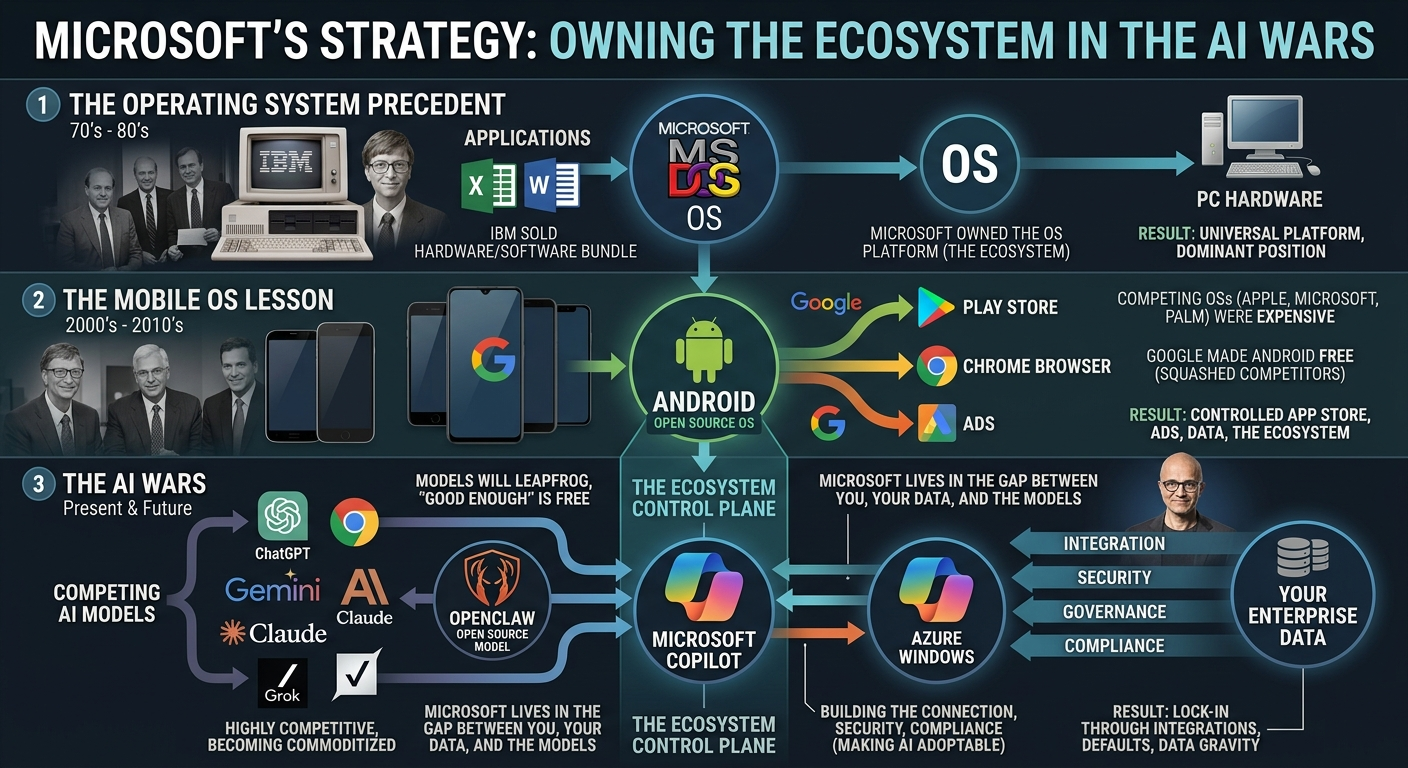
To give a little history, Bill Gates founded Microsoft on the operating system. As the story goes, IBM was building computers and needed an operating system. IBM was the computer company in the 70's.
They didn't just dominate the computing industry. They were the industry.
IBM made money the old-fashioned way. By selling you hardware and bundling software inside the hardware. Then the personal computer (PC) came along.
IBM needed something, and fast. Then they met Bill Gates, the Microsoft founder.
Bill said, "I'll build the OS, but I want to own it." IBM, believing the money was in the hardware, said, "Great, let's do that." That one decision from Bill and IBM changed the world.
You see, in that decision, Microsoft became the behemoth. Microsoft owned the ecosystem around the PC. They were the platform you built apps for. They were the platform everyone became accustomed to.
It didn't matter if you used a Dell, IBM, or HP computer; as long as it had the Microsoft OS, you were fine with it.
A few decades later, IBM is still a powerhouse. They build enterprise hardware, run clouds, power a lot. But Microsoft? Everyone has heard of Microsoft.
But this wasn't the only time Microsoft has run into question, and they haven't always chosen correctly.
Lessons Learned From Mobile OS
Many years ago, there were a number of competing operating systems for the mobile landscape. From Apple to Google to Blackberry to Palm to Microsoft. There were a ton of names in the mobile OS landscape. Then Google made a move.
They went open source. With that move, Google expanded its reach, squashing the competitors like bugs. After Google went open source, no one else could compete on price. And Google owned the one thing that mattered.
The ecosystem.
Google was able to show more ads to everyone who used the OS. They were able to make their Play Store the mobile app store where you made purchases. They were able to launch Google Chrome's mobile version into the stratosphere. You get the picture, right?
Google made the operating system free to crush competitors, then owned the ecosystem around the mobile devices.
These aren't the only two instances of the tech world competing based on ecosystems, but you get it.
Now, we are heading to the latest war. The AI wars, and thanks to OpenClaw, it looks like Microsoft chose correctly.
The AI Race Heated Up
We are in the AI race. Everyone was racing to build a bigger, smarter model. Microsoft seemed to know. They said, "We don't want to compete in building models. We want to compete in the ecosystem around the models."
Af first, it seemed crazy. ChatGPT was all everyone was talking about. Then Google came into the fray. Then Claude, Then Facebook. Then X. Then OpenClaw.
The AI models are busy and competitive. How are any of them to make any money when a dozen competitors are nipping at their heels?
Microsoft seemed to know it too. They invested in multiple competitors to almost keep them in the race.
You know what's not that competitive? The control plane around all these models. The ecosystem that supplies your complexity to these models.
That's where Microsoft is living. Microsoft is living in the space between you, your data, and the AI models.
That's where Microsoft decided to compete. In the ecosystem. Starting to see a pattern?
It's bringing AI into the flow of work. It's building out the security so you know what your AI agents are doing and when. You know what they are accessing, what emails they are sending, what document changes they are making.
That's where Microsoft is living.
So while everyone else is competing on the models. Microsoft is quietly building. It's building the connection between the AI models and everything you need to get done.
Compliance, security, governance, and integration are critical for AI adoption at scale in enterprises. And that's where Microsoft is bridging the gap. In all the places that make AI scary and unusable for businesses. That's where Microsoft is building the future.
Thanks in large part to the competitiveness of all these different models. And the final nail in the head?
OpenClaw
Now that there are open-source AI models, the price you'll pay for the model will never be much. Because the free version just needs to be good enough.
Think about it like this. Google Maps has an issue with a couple of highway intersections near me. They don't tell me if I need to stay left or stay right until I'm on top of the exits. Do I look for a competitor? No, I live with it. Why? Because the free Google Maps is good enough.
And that's what OpenClaw will do with the AI models. Will Gemini be better at images or get ahead on video? Sure, but OpenClaw will be good enough.
Will Claude be better at coding? Probably. But OpenClaw will be good enough.
Will Facebook and Grok find their place to outperform the other models? Probably. But OpenClaw will be good enough.
You see, that's the challenge that IBM had. That's the challenge that mobile OSs like Windows had. The free version is good enough, so why would I pay more?
And that's the challenge of the AI models. I can build an almost fully automated website with Copilot, ChatGPT, Gemini, Grok.
I can build a web game in under an hour with any of these models.
I can't get answers on my data as easily with other models as I can with Copilot. Sure, we may be able to upload it. But what will Google, OpenAI, Facebook, or X do with your data? How would the company you work for feel about you uploading confidential data to a company that probably has unlimited rights to that data once it's uploaded?
If you asked me to help you find the AI model of the future, I’d tell you to stop worrying about the model entirely. That’s not where the future is. The real signal isn’t in who has the smartest model this quarter. It’s in the ecosystem around it. The integrations, the data gravity, the developer habits, the defaults people don’t even question anymore. Models will keep leapfrogging each other. The ecosystem? That’s what quietly locks everything in place.